
Color Blindness: Understanding Red-Green Defects and How They're Inherited
Most people think color blindness means seeing the world in black and white. That’s not true. The most common form-red-green color blindness-isn’t blindness at all. It’s a mismatch in how your eyes detect certain colors. You see plenty of colors. You just can’t tell red from green, or orange from brown, or certain shades of purple from gray. And it’s not random. It’s passed down through genes, mostly from mom to son.
Why Men Are More Likely to Be Affected
If you’re a man, you have about a 1 in 12 chance of having red-green color blindness. If you’re a woman, it’s about 1 in 200. That’s not because men see worse-it’s because of biology. The genes that control red and green color vision sit on the X chromosome. Men have one X and one Y chromosome. Women have two X chromosomes.So if a man inherits a faulty version of the color vision gene on his single X chromosome, he has no backup. He’ll be affected. A woman needs two faulty copies-one on each X chromosome-to have the condition. That’s rare. Even if she has one bad copy, her other X chromosome usually compensates. That’s why only about 0.5% of women have red-green color blindness, compared to 8% of men.
This pattern is called X-linked recessive inheritance. It’s the same reason hemophilia and Duchenne muscular dystrophy show up more often in men. It’s not a choice. It’s not lifestyle. It’s pure genetics.
What Actually Goes Wrong in the Eye
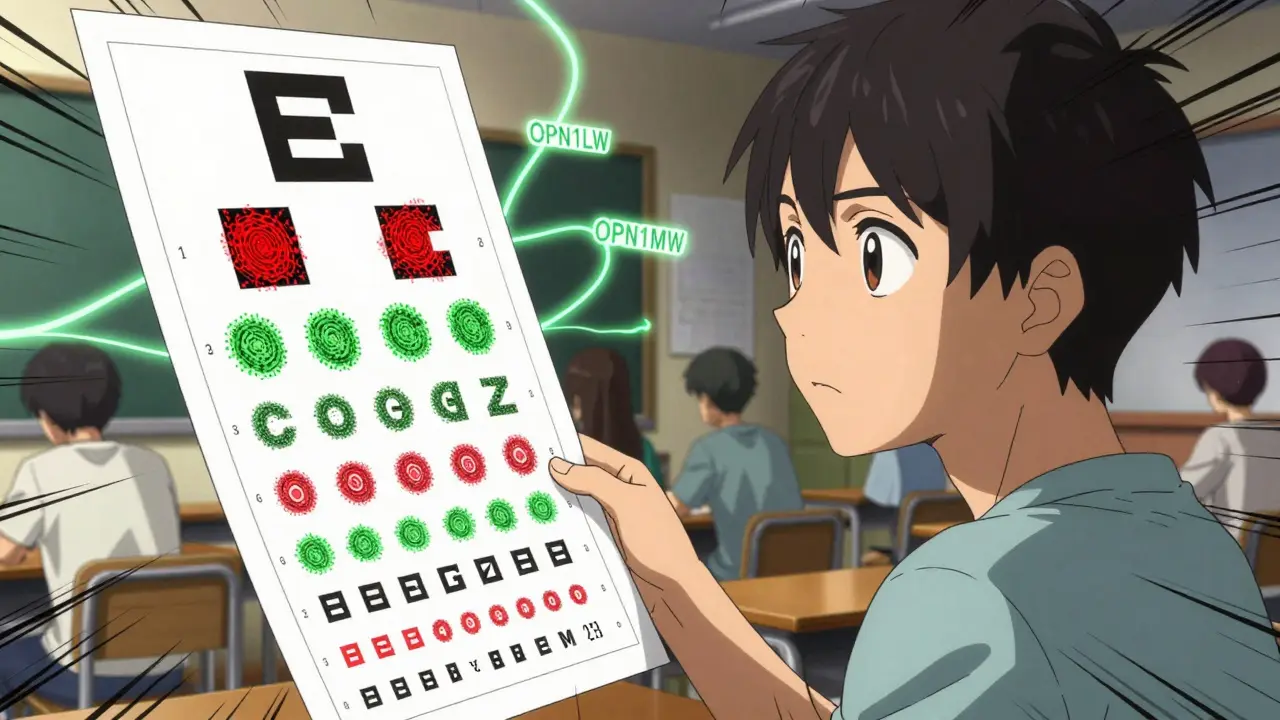
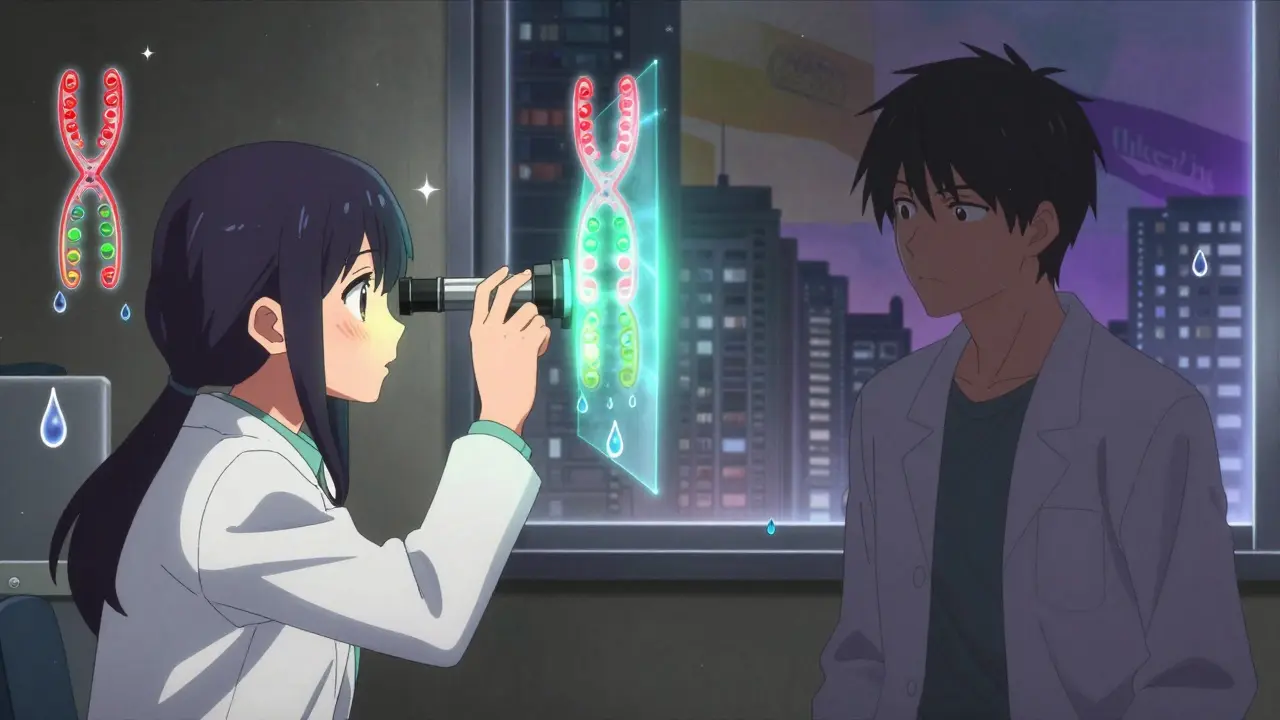
Your retina has three types of cone cells that detect color: one for red, one for green, and one for blue. The red and green cones are the ones that cause trouble. Their light-sensitive proteins-called photopsins-are made by two genes: OPN1LW (red) and OPN1MW (green). These genes sit right next to each other on the X chromosome.Here’s the twist: you don’t just have one red gene and one green gene. You have a whole string of them-usually one red followed by several green. During egg or sperm formation, these genes can accidentally swap pieces. That’s called unequal crossover. Sometimes, a person ends up with no red gene at all. Or their green gene gets mixed up and doesn’t work right.
This leads to four main types of red-green color blindness:
- Protanopia: No functional red cones. Reds look dark, almost black. Greens and yellows can look similar.
- Deuteranopia: No functional green cones. This is the most common form. Reds and greens are hard to tell apart.
- Protanomaly: Red cones are faulty, not gone. Colors look duller, especially reds.
- Deuteranomaly: Green cones are faulty. This affects about 5% of men and is the most common type overall.
Deuteranomaly is so common because the green gene is more likely to mutate or get swapped during inheritance. The red gene is more stable, but when it fails, the effect is stronger.
How It’s Diagnosed-and Why It Matters
The Ishihara test is the most famous way to check for red-green color blindness. It uses colored dots arranged in circles to form numbers. People with normal vision see one number. People with color blindness see a different number-or nothing at all.But the Ishihara test isn’t perfect. It can miss mild cases. And it doesn’t tell you what kind of deficiency you have. More advanced tests, like the Farnsworth-Munsell 100 Hue Test or the anomaloscope, give a clearer picture. These are used in clinical settings, especially for jobs where color matters.
That’s where it gets real. Pilots, electricians, firefighters, and graphic designers often face barriers. A commercial pilot applicant with protanopia was turned down-not because he couldn’t fly, but because he couldn’t distinguish red and green runway lights. An electrician told me he once wired a panel wrong because he mixed up the red and green wires. He now labels everything with numbers.
And it’s not just jobs. Traffic lights can be confusing in fog or glare. Color-coded charts in school or at work can be impossible to read. A 2022 survey found that 78% of people with red-green color blindness struggled with color-coded educational materials. That’s not a design flaw-it’s a failure to account for how people actually see.
Tools That Help-And What Doesn’t Work
There’s no cure. You can’t fix the genes. But you can adapt.EnChroma glasses, introduced in 2012, are the most talked-about solution. They cost between $329 and $499. They don’t give you normal color vision. They don’t cure anything. But for about 80% of people with deuteranomaly or protanomaly, they make colors pop. Reds look redder. Greens look greener. It’s not magic-it’s filtering out overlapping wavelengths so the brain gets cleaner signals.
But they don’t work for everyone. People with complete absence of a cone type (dichromats) get little to no benefit. And they’re useless in low light. They’re a tool, not a fix.
Software helps more than people realize. Apple and Windows both have built-in color filters. You can turn your screen grayscale, invert colors, or simulate what someone with red-green deficiency sees. Designers use tools like Color Oracle and Sim Daltonism to test websites before launch. The Colorblindifier plugin for Photoshop has been downloaded over 45,000 times.
And then there’s ColorADD-a system developed in Portugal that uses simple shapes to represent colors. A triangle is red. A square is green. A circle is blue. It’s now used in public transit systems in 17 countries. No one has to guess what color a sign is.
What It’s Like to Live With It
I talked to someone who’s had deuteranomaly since birth. She’s a graphic designer. “I used to stress over matching shirts,” she said. “Now I just buy black, gray, navy. It’s easier.” She uses apps to identify colors when she’s unsure. She’s learned to rely on brightness, not hue. “I can tell a red and green apart if one is brighter than the other. That’s how I work now.”Another guy, a college student, said he failed his first biology quiz because he couldn’t tell the difference between red and green in a DNA gel image. He didn’t know he had color blindness until then. His school now offers accessible materials on request.
Most people don’t see it as a disability. A 2022 survey found 92% of those with red-green color blindness consider it a minor inconvenience. But 37% said they’ve been embarrassed-like when they wore mismatched socks or picked the wrong fruit at the grocery store.
It’s not about being “broken.” It’s about being different. And difference isn’t weakness. It’s just data the world wasn’t designed for.

The Future: Gene Therapy and Better Design
In 2022, scientists at the University of Washington gave gene therapy to adult squirrel monkeys with red-green color blindness. Within weeks, they started seeing colors they’d never seen before-and kept seeing them for over two years. It’s not human-ready yet. But it’s proof the brain can learn new color signals, even as an adult.The National Eye Institute is investing millions to explore this further. Their goal? Restore full color vision-not just improve it.
In the meantime, design is catching up. The Web Content Accessibility Guidelines (WCAG 2.1) now require that information not rely on color alone. Buttons need labels. Charts need patterns. Traffic signs need shapes. The European Union’s Accessibility Act requires public websites to follow these rules. Microsoft, Apple, and Google all have color accessibility features built in.
By 2030, experts predict adaptive tech will cut the functional impact of red-green color blindness by half. Augmented reality glasses could label colors in real time. Smartphones might auto-adjust images based on your vision profile.
It’s not about fixing people. It’s about fixing the world around them.
What You Should Do If You Suspect Color Blindness
If you’ve ever struggled to match colors, confused traffic lights, or been told you’re “bad with colors,” get tested. It’s easy. Many optometrists offer basic screening. Online tests aren’t reliable, but they can hint at a problem.If you’re diagnosed:
- Don’t panic. You’re not alone. Millions live full, successful lives with this condition.
- Use tools. Color filters on your phone, apps that identify colors, labeling systems.
- Advocate. Ask for color-accessible materials at school or work.
- Teach others. Many people don’t realize how much color matters in daily life.
And if you’re a designer, teacher, or developer? Don’t just use color. Add patterns, labels, contrast, and texture. Make your work work for everyone-not just the 92% who see color the way you do.
Can color blindness get worse over time?
No. Red-green color blindness is congenital and doesn’t change with age. Unlike cataracts or macular degeneration, it doesn’t progress. What you’re born with is what you’ll have for life. But your brain gets better at adapting-you learn to rely on brightness, context, and labels instead of hue.
Can women be color blind?
Yes, but it’s rare. A woman needs two faulty copies of the gene-one on each X chromosome-to have red-green color blindness. Since the condition affects about 8% of men, and women inherit one X from each parent, the math suggests about 0.64% of women should be affected. In reality, it’s closer to 0.5% because of X-chromosome inactivation, where one X is randomly turned off in each cell. This can sometimes mask the condition even in carriers.
Do EnChroma glasses really work?
They work for about 80% of people with deuteranomaly or protanomaly, but not for those with complete absence of red or green cones. They don’t cure color blindness. They filter light to reduce overlap between red and green signals, helping the brain distinguish them better. Results vary by person. Some report life-changing clarity. Others notice little difference. They’re expensive, so try a rental or demo first.
Is color blindness considered a disability?
Legally, yes-in many places. The UK’s Equality Act 2010 and the U.S. Americans with Disabilities Act recognize color vision deficiency as a disability when it limits major life activities, like driving or working in certain fields. Employers must provide reasonable accommodations, like labeled wires or color-safe software. It’s not about pity-it’s about access.
Can you outgrow color blindness?
No. Color vision deficiency is genetic and permanent. You can’t train yourself to see colors differently. But you can train yourself to notice other cues-like brightness, position, or texture. Many people with color blindness develop sharper skills in these areas. They don’t see more colors-they see more details.



About Author






Okay but let’s be real-this whole ‘color blindness isn’t a disability’ narrative is so woke it’s embarrassing. If you can’t tell red from green, you shouldn’t be driving, let alone designing apps or wiring circuits. This isn’t ‘difference,’ it’s a safety hazard disguised as identity politics. I’ve seen guys mix up stop lights and nearly cause accidents. Fix the world? No. Fix the person. Or better yet-don’t let them near anything that requires color vision. End of story.
Oh my gosh, I just cried reading this 😭 I’m a graphic designer with deuteranomaly and I’ve spent YEARS guessing if my shirt matches my pants. The EnChroma glasses? Life-changing. I saw a red rose for the first time and it felt like magic. 🌹❤️ Green isn’t just green anymore-it’s *alive*. And yes, I know they’re expensive, but if your job or life depends on color, it’s worth it. Also-thank you for mentioning ColorADD. I used it on my wedding invitations. No one knew, but I did. And that mattered.
While the article presents a comprehensive overview of X-linked recessive inheritance patterns associated with red-green color vision deficiencies, it is imperative to acknowledge the methodological limitations of self-reported survey data cited in the conclusion. Specifically, the 92% ‘minor inconvenience’ statistic lacks peer-reviewed validation and may be subject to response bias. Furthermore, the assertion that ‘the brain can learn new color signals’ as demonstrated in squirrel monkey models requires longitudinal human trials before extrapolation to clinical practice. The ethical implications of gene therapy, particularly in non-life-threatening conditions, warrant further bioethical scrutiny.
My uncle’s a pilot. He’s color blind. Never had an issue. He just memorizes which light is on top. Same with electricians-they label wires. I think we make this way harder than it needs to be. People adapt. It’s not a crisis. Just… different.
ok but i just found out i might be color blind and now i’m panicking because i thought my purple shirt was blue and my green pants were black?? like… i’ve been wearing mismatched stuff my whole life?? 😭 i used to get made fun of for it. now i feel so seen. also i just downloaded a color id app and it’s kinda wild. my dog’s leash is ‘magenta’?? what even is that??
People think color blindness is just a visual thing. Nah. It’s a mental game. You learn to read context like a spy. Traffic light? Top is always red. Green is bottom. Wires? Numbers don’t lie. You become hyper-aware of texture, shape, position. It’s not a weakness. It’s a skill. And honestly? You start noticing things others miss.
Let’s deconstruct the epistemological framework of chromatic perception. The Cartesian binary of ‘normal’ vs. ‘deficient’ vision is a colonial construct-a hegemonic imposition of trichromatic normativity upon the spectrum of human sensory experience. We are not broken; we are *unmapped*. The red-green dichotomy is not a biological flaw-it is a cultural artifact of industrial design that privileges a narrow perceptual bandwidth. The gene therapy trials? Not a cure. A colonial intervention. The real revolution isn’t in the retina-it’s in the refusal to conform. Embrace the ambiguity. The world doesn’t need to adapt to us-we need to dismantle the very architecture of color-as-information. Let the cones be free.
As a cultural anthropologist who has studied color perception across 14 indigenous communities, I can affirm that the Western fixation on ‘correct’ color identification is both culturally specific and historically contingent. In some Pacific Islander societies, color is not categorized by hue but by luminosity and context-rendering the concept of ‘color blindness’ largely irrelevant. This article, while scientifically accurate, inadvertently reinforces a Eurocentric model of vision as the universal standard. Perhaps the question is not how to fix color blindness-but how to expand our definition of seeing.
Wait-I just read this article, and I’m a 42-year-old man who’s always thought he was ‘bad with colors.’ I got tested last week. Deuteranomaly. Mild. I’ve been wearing mismatched socks for 20 years. I thought I was just clumsy. I never knew. I didn’t even know it was genetic. I thought I was just… bad at fashion. This changes everything. I’m going to tell my daughter. She’s 8. She picks out all the clothes. Maybe she’s got it too. I need to get her checked. Thank you for writing this.
My brother’s color blind. He’s a chef. He uses texture and smell more than color. He says he can tell if a steak is medium-rare by how it feels, not by the red juice. He taught me to look at the edges of leaves to tell if a plant is healthy-not the color, but the crispness. He doesn’t see the world like me. But he sees more of it. Honestly? He’s the most observant person I know.
I’m a teacher. I just redesigned all my science handouts with patterns and labels. No more red/green graphs. I used dots, stripes, zigzags. The kids who struggled? Now they’re acing quizzes. One kid said, ‘I didn’t know I was color blind until now.’ I cried. Not because he was ‘deficient’-because the system failed him. We don’t need to fix kids. We need to fix our materials. And honestly? Everything looks better with patterns anyway.