

Bupropion Side Effects: What You Need to Know About Insomnia, Anxiety, and Seizure Risk
Bupropion is one of the most commonly prescribed antidepressants in the U.S., with over 17 million prescriptions filled in 2022. Brands like Wellbutrin, Zyban, and Aplenzin all contain this drug, and it’s often chosen because it doesn’t cause the sexual side effects or weight gain that many other antidepressants do. But that doesn’t mean it’s without risks. For every person who finds relief without sexual problems or weight gain, another might struggle with sleepless nights, jittery anxiety, or even a seizure they never saw coming. If you’re considering bupropion-or already taking it-here’s what you really need to know about its most serious side effects: insomnia, anxiety, and seizure threshold.
Why Bupropion Is Different From Other Antidepressants
Most antidepressants, like fluoxetine (Prozac) or sertraline (Zoloft), work by boosting serotonin in the brain. Bupropion is different. It targets dopamine and norepinephrine instead. That’s why it’s called an atypical antidepressant. This unique mechanism is why it doesn’t mess with your sex drive the way SSRIs often do. Studies show only 1-6% of people on bupropion report sexual side effects, compared to 30-70% on SSRIs. It’s also one of the few antidepressants linked to weight loss instead of gain-about 23% of users lose weight on it. But this same mechanism is also why bupropion can cause problems others don’t. Dopamine and norepinephrine are stimulant-like neurotransmitters. Too much of them, especially early in treatment, can overfire your nervous system. That’s the root cause of insomnia, anxiety, and the increased seizure risk.Insomnia: The Most Common Sleep Killer
About 19% of people taking bupropion report trouble sleeping. That’s higher than most other antidepressants, which typically cause insomnia in 10-15% of users. For some, it’s mild-just a harder time falling asleep. For others, it’s brutal: lying awake until 3 a.m., heart racing, mind spinning. One Reddit user wrote, “I took my last dose at 7 p.m. and still couldn’t sleep until 5 a.m. for three weeks straight.” The reason? Bupropion’s effects peak in the bloodstream 3-5 hours after taking it, depending on the formulation. If you take it too late in the day, your brain is still buzzing when you’re trying to wind down. The FDA and Mayo Clinic both recommend taking bupropion in the morning, and never within 6 hours of bedtime. If you’re on the extended-release version (XL), take it once in the morning. If you’re on the sustained-release (SR), split the dose-first in the morning, second no later than noon. Some people find that switching from SR to XL helps. The XL version releases the drug more slowly, so it doesn’t spike as sharply. That reduces the “crash and burn” effect that keeps people up. In clinical practice, about 68% of patients who moved to morning-only XL dosing saw their sleep improve within two weeks.Anxiety and Agitation: The First Two Weeks Are Critical
Anxiety isn’t just a side effect-it’s a red flag. About 20-25% of people on bupropion report nervousness, restlessness, or agitation, especially in the first 1-2 weeks. This isn’t your usual “I’m stressed” anxiety. It’s a physical jitteriness: trembling hands, racing thoughts, feeling like you’re on edge even when nothing’s happening. Clinically, this is called “activation syndrome.” It happens because dopamine and norepinephrine levels rise faster than your brain can adapt. Most people get through it. Symptoms usually fade after a week or two as your brain adjusts. But for 1 in 5, it doesn’t. That’s when people quit. Doctors sometimes pair bupropion with a short-term benzodiazepine like lorazepam for the first 10 days to calm the nervous system. Others reduce the starting dose-from 150mg down to 75mg-and go slower. If your anxiety is severe enough to make you panic, avoid driving, or cause suicidal thoughts, you need to talk to your provider immediately. Don’t wait. This isn’t normal adjustment-it’s a warning sign.
Seizure Risk: The Silent Threat
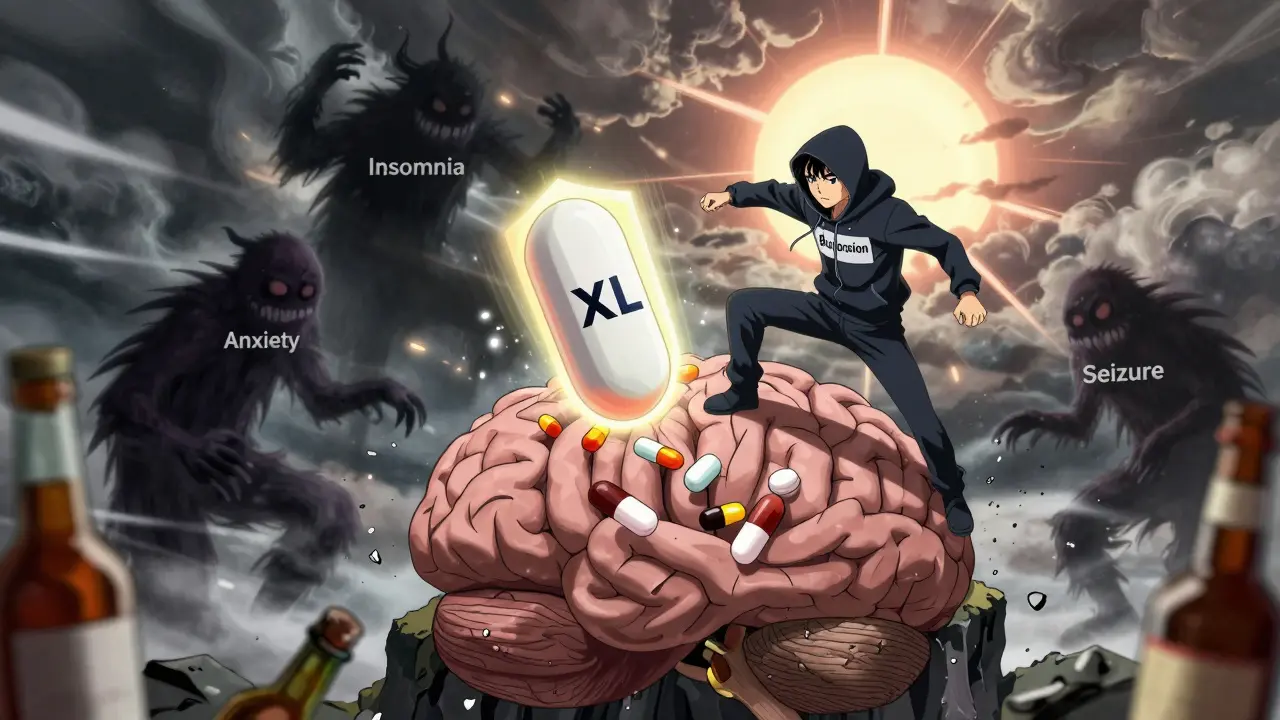
This is the most dangerous side effect-and the one most people don’t know about. In the general population, the chance of having a seizure is about 0.01% per year. With bupropion at the maximum recommended dose (450mg/day for SR, 400mg/day for XL), that risk jumps to 0.4%. Sounds low? It is-until you realize that risk skyrockets to 2-5% if you go over 600mg/day. The seizure risk isn’t random. It’s tied to how fast the drug hits your bloodstream. That’s why the immediate-release form (no longer commonly prescribed) had the highest risk. The sustained-release (SR) version is riskier than extended-release (XL) because it releases the drug faster, creating higher peak levels. The FDA approved a new XL formulation in June 2023 specifically to lower these peaks and reduce seizure risk. Certain people are at much higher risk: those with a history of seizures, head injuries, brain tumors, severe liver disease, eating disorders (like anorexia or bulimia), or those who drink heavily or use stimulants like cocaine or Adderall. Even stopping alcohol cold turkey while on bupropion can trigger a seizure. One case report from 2023 described a 35-year-old woman who had her first seizure after increasing her SR dose to 300mg. She had no prior history. Her doctor didn’t know she’d been drinking 2-3 beers nightly to sleep. That combination was enough to push her over the edge. Watch for warning signs: muscle twitching, uncontrolled jerking, staring spells, or sudden confusion. If you feel any of these, stop the drug and get medical help immediately. Don’t wait for a full-blown seizure.Who Should Avoid Bupropion Altogether?
Bupropion isn’t for everyone. Here are the clear red flags:- You’ve ever had a seizure
- You have an eating disorder (anorexia, bulimia)
- You’re currently withdrawing from alcohol or sedatives
- You’re taking other drugs that lower seizure threshold (like antipsychotics, stimulants, or certain antibiotics)
- You have severe liver disease
- You’re already on another antidepressant that causes anxiety or insomnia
What to Do If You’re Already on Bupropion
If you’re taking bupropion and having side effects, don’t quit cold turkey. That can cause withdrawal symptoms like headaches, nausea, or mood swings. Instead:- Track your doses and timing. Are you taking it too late?
- Check your daily dose. Are you over 400mg (XL) or 450mg (SR)?
- Rate your anxiety and sleep on a scale of 1-10 each day for a week.
- Write down any physical symptoms: twitching, dizziness, palpitations.
- Schedule a call with your prescriber. Bring your notes.
Real Stories: What Patients Say
On GoodRx, bupropion has a 6.3/10 rating. The reviews split cleanly:- Positive: “Finally, an antidepressant that didn’t kill my libido.” “Helped me quit smoking and I lost 12 pounds.”
- Negative: “I couldn’t sleep for 6 weeks.” “I had panic attacks so bad I ended up in the ER.” “I had a seizure at 300mg. Never again.”
The Bottom Line
Bupropion is a powerful tool. For the right person, it can change their life-freeing them from sexual side effects, weight gain, or even helping them quit smoking. But it’s not a gentle drug. It’s a stimulant in antidepressant clothing. If you’re considering it, ask yourself: Are you willing to risk sleepless nights and anxiety to avoid weight gain? Are you prepared to stop taking it cold if you feel a twitch in your arm? Talk to your doctor about your full history: sleep patterns, anxiety, substance use, seizures, liver health. Don’t assume it’s safe just because it’s popular. Millions take it. Thousands have had bad reactions. Your job is to know if you’re in the majority-or the minority at risk. If you’re already on it and something feels off-trust that feeling. Your nervous system is talking. Listen before it screams.Can bupropion cause seizures even at normal doses?
Yes, though it’s rare. At the maximum recommended dose (450mg/day for sustained-release or 400mg/day for extended-release), the seizure risk is about 0.4%, which is 40 times higher than the general population. Risk increases sharply above 600mg/day. Even at normal doses, people with a history of seizures, head injuries, eating disorders, or liver disease are at higher risk. The drug’s peak plasma concentration is the main trigger, which is why extended-release formulations are safer than sustained-release.
How long does bupropion-induced insomnia last?
For most people, insomnia improves within 1-2 weeks as the body adjusts. But if you’re taking it too late in the day, it can last much longer. Moving your dose to earlier in the morning-ideally before noon-helps 68% of patients. Switching from sustained-release (SR) to extended-release (XL) can also reduce nighttime stimulation. If insomnia persists beyond three weeks, talk to your doctor about lowering the dose or switching medications.
Does bupropion make anxiety worse before it gets better?
Yes, many people experience increased anxiety, nervousness, or agitation in the first 1-2 weeks. This is called activation syndrome and is caused by the sudden rise in dopamine and norepinephrine. For most, it fades as the brain adapts. But if your anxiety becomes severe-causing panic attacks, inability to function, or suicidal thoughts-you should contact your doctor immediately. Do not wait. This is not normal adjustment; it’s a sign the drug may not be right for you.
Is it safe to drink alcohol while taking bupropion?
No, it’s not safe. Alcohol lowers your seizure threshold, and bupropion raises it. Combining them can trigger a seizure even at normal doses. This risk is highest if you drink regularly and then stop suddenly while on bupropion-common in people who quit drinking to improve their mental health. Even moderate drinking (1-2 drinks per day) increases risk. Most doctors recommend avoiding alcohol completely while on bupropion.
What’s the safest way to stop taking bupropion?
Never stop abruptly. Tapering down slowly over 1-2 weeks reduces the risk of withdrawal symptoms like headaches, nausea, irritability, or mood swings. Your doctor should guide your taper schedule. For example, if you’re on 300mg/day, you might drop to 150mg for a week, then stop. If you’re on the extended-release version, your doctor may switch you to a lower-dose tablet before tapering. Always consult your provider before making any changes.


About Author





I was on Wellbutrin for 8 months and it was a GAME CHANGER for my libido and weight. But oh god, the insomnia. I was up until 5 a.m. every night like my brain was on espresso. Switched to XL and moved my dose to 7 a.m. and boom - slept like a baby. 🙌
This article is dangerously oversimplified. You imply that bupropion is merely a 'stimulant in antidepressant clothing' - as if the entire pharmacological paradigm of neurotransmitter modulation is reducible to a cartoon. The seizure risk is statistically negligible for healthy individuals, yet you stoke fear without contextualizing population baselines. This is medical misinformation dressed as advice.
i took bupropion sr for 3 weeks and started having like… little muscle twitches in my arm. didn’t think much of it. then one night i woke up with my whole body shaking. turned out it was a mini-seizure. doc said i was lucky. i’m still scared to take anything again. 🤢
Activation syndrome is real-and underdiagnosed. If someone presents with agitation, psychomotor restlessness, and insomnia within the first 10 days, don’t just 'wait it out.' That’s not resilience, that’s iatrogenic harm. Titrate slower. Consider adjunctive low-dose mirtazapine for sedation. Or switch. Your brain isn’t a beta test.
Look, I get it. People want a magic pill that fixes depression without making them feel like a zombie or turning their genitals into concrete. But bupropion? It’s like giving a caffeine addict a jet engine and saying, 'Hey, maybe don’t drink coffee anymore.' It’s not that it doesn’t work-it’s that it works too damn hard, and your nervous system isn’t built for that kind of pressure. I’ve seen too many people go from 'I feel alive!' to 'I think I’m dying' in two weeks. And no, 'it gets better' isn’t an answer when your heart’s pounding like a jackhammer and you can’t breathe.
USA: 17 million prescriptions. That’s not a miracle. That’s a national experiment on our brains. And guess who pays the price? The people who can’t afford to quit when it goes wrong. Meanwhile, pharma’s laughing all the way to the bank. Bupropion isn’t treatment-it’s a corporate product with a side of seizures.
Took it. Insomnia. Stopped. Better sleep. No regrets.
I’ve been a psychiatric nurse for 12 years. I’ve seen bupropion save lives-and ruin them. The key? Personalization. Dose timing. Screening for alcohol use. Monitoring for twitching. It’s not a one-size-fits-all drug. If your provider isn’t asking you about your sleep, your drinking, your history of head trauma-you need a new provider.
i took it for 3 weeks and felt like a robot on a caffeine bender. then i started having these weird blank spells… like i’d zone out for 5 seconds. didn’t tell anyone. scared. now i just take trazodone and call it a day. 🤷♀️
You know what’s worse than bupropion? Doctors who push it because they’re tired of hearing about sexual side effects. They don’t care if you’re up all night shaking. They just want you to stop complaining. I had to go to three doctors before someone listened. Don’t trust the system.
This is all part of the mind control agenda. The FDA approves bupropion because it’s cheap and keeps people docile while the government monitors their brainwaves through their phones. The 'seizure risk' is just a cover. They want us paranoid so we’ll take more pills. And the insomnia? That’s just the signal jamming kicking in. I stopped taking it… and my dreams got clearer. Coincidence? I think not.
To anyone reading this and feeling scared: you’re not alone. I was terrified when I started shaking after my first dose. But I called my doctor. We lowered the dose. I switched to XL. I started meditating. It took time-but I’m here. You can get through this. Your mental health matters more than any pill. 💪❤️
Okay so I was on 300mg SR because my doc said 'it’s fine' but I was drinking 3 beers a night to sleep because I was so anxious. One night I woke up on the floor. No memory. EMS came. Seizure. Turned out my liver was stressed from the booze + bupropion. Now I’m on sertraline. And I haven’t had a single nightmare since. Also, my ex still texts me 'you’re so much calmer now.' LOL. I’m alive. That’s the win.
took bupropion for 6 months. lost 15 lbs. quit smoking. slept like a log after i switched to morning-only XL. no anxiety. no jitters. it’s not for everyone-but for me? it was the missing piece. listen to your body. tweak the dose. don’t rush. you got this.