
Bleeding Risk from SSRIs: How Platelet Dysfunction Increases Bleeding Danger
SSRI Bleeding Risk Assessment Tool
Assess Your Bleeding Risk
This tool helps you understand your personalized risk based on the SSRI you're taking, other medications, and health factors. Results are for informational purposes only and should not replace professional medical advice.
Your Personalized Risk Assessment
Why SSRIs Can Make You Bleed More Easily
Most people take SSRIs to feel better-less anxiety, fewer depressive episodes, more energy. But few know that these common antidepressants can also make you bleed more easily. It’s not a rumor. It’s not rare. It’s built into how SSRIs work at the cellular level. If you’re on one of these drugs, especially if you’re also taking blood thinners or NSAIDs, you need to understand what’s happening inside your body.
How SSRIs Actually Work (And Why That Causes Bleeding)
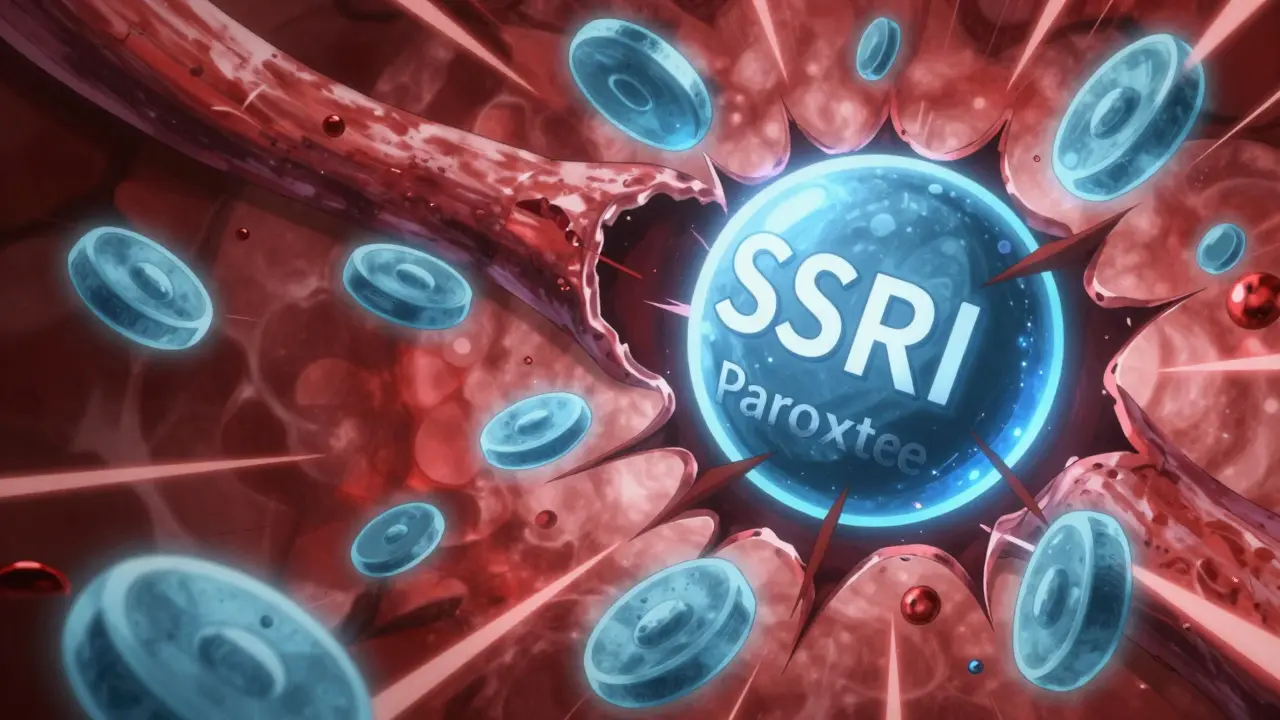
SSRIs like sertraline, fluoxetine, and paroxetine stop your brain from reabsorbing serotonin. That extra serotonin helps lift your mood. But here’s the catch: 99% of your body’s serotonin isn’t in your brain. It’s in your platelets-the tiny blood cells that plug leaks in your blood vessels. Platelets need serotonin to stick together and form clots when you cut yourself or bruise. When SSRIs block serotonin uptake into platelets, those cells become sluggish. They don’t respond as quickly or as strongly to injury. That’s called platelet dysfunction.
Think of it like a fire alarm that’s been disconnected. The smoke is still there, but the alarm won’t sound. Your body still senses bleeding, but the platelets can’t signal or recruit help properly. Studies show serotonin levels in platelets drop by more than 80% in people taking paroxetine. That’s not a small change. That’s a major disruption to your natural clotting system.
Not All SSRIs Are the Same When It Comes to Bleeding
Some SSRIs are much stronger at blocking serotonin uptake than others. This matters a lot. Paroxetine has the tightest grip on the serotonin transporter-its binding strength (Ki = 0.17nM) is nearly three times stronger than sertraline’s (Ki = 0.52nM). That’s why paroxetine carries the highest bleeding risk. Fluvoxamine is close behind. Citalopram and sertraline are safer bets if bleeding is a concern.
Real-world data backs this up. In the FDA’s adverse event database, paroxetine users reported easy bruising and nosebleeds nearly twice as often as sertraline users. A 2022 Reddit thread with over 300 user reports found that 74% of those who had unusual bleeding were on paroxetine, while only 32% were on sertraline. On Drugs.com, 18.7% of paroxetine users mentioned easy bruising as a side effect. For sertraline? Just 9.2%.
When SSRIs Combine With Other Drugs, Risk Skyrockets
The biggest danger isn’t SSRIs alone. It’s SSRIs mixed with other medications that also affect bleeding.
- Anticoagulants (warfarin, apixaban, rivaroxaban): Using an SSRI with a blood thinner increases your risk of major bleeding by 35%, according to a 2024 JAMA Network Open meta-analysis.
- NSAIDs (ibuprofen, naproxen): These painkillers irritate your stomach lining and reduce platelet function too. When combined with SSRIs, bleeding risk jumps 4.5 times. That’s why doctors often switch patients from ibuprofen to acetaminophen.
- Antiplatelet drugs (aspirin, clopidogrel): After a heart attack or stent, many people take these. Studies show that SSRIs can add to the bleeding risk here-but newer antiplatelets like ticagrelor seem to offset the effect better than older ones.
One study followed heart patients who had stents placed. Even though they were on potent antiplatelet drugs, those taking paroxetine had more bleeding events than those on sertraline. The takeaway? It’s not just about the drug you’re on-it’s about the combo.
Who’s Most at Risk?
You’re at higher risk if you have:
- A history of ulcers or gastrointestinal bleeding
- Chronic kidney or liver disease
- High blood pressure
- Are over 65
- Take multiple medications that affect clotting
Doctors use a tool called the HAS-BLED score to check this. It looks at Hypertension, Abnormal kidney/liver function, Stroke history, Bleeding history, Labile INR (if on warfarin), Elderly age, and Drugs/alcohol use. If your score is 3 or higher, you’re in the high-risk group. That’s when switching from paroxetine to sertraline-or even to a non-SSRI like bupropion-becomes a real option.
What You Should Do If You’re on an SSRI
You shouldn’t stop your SSRI without talking to your doctor. Depression is dangerous too. But you can take smart steps:
- Know your SSRI’s risk level. Paroxetine and fluvoxamine = higher risk. Sertraline and citalopram = lower risk.
- Avoid NSAIDs. Use acetaminophen instead for pain or headaches.
- Tell every doctor you see. Even your dentist. If you’re having surgery, they may ask you to stop the SSRI 5-7 days before. But not always-cardiac surgery patients often stay on SSRIs because the risk of depression relapse is worse than bleeding.
- Watch for warning signs. Unexplained bruising, nosebleeds that won’t stop, dark or tarry stools, vomiting material that looks like coffee grounds-these are red flags. Call your doctor immediately.
- Ask about genetic testing. A new 2024 study found that people with the S/S version of the 5-HTTLPR gene have over twice the bleeding risk on SSRIs. Testing isn’t routine yet, but it’s coming.
What’s Changing in 2025?
Doctors are getting smarter about this. Electronic health records now flash alerts when someone is prescribed an SSRI along with warfarin or aspirin. In 2021, one major hospital system saw a 22% drop in dangerous SSRI-anticoagulant combos after adding these alerts.
Pharmaceutical companies are updating labels too. Paroxetine’s FDA-approved package insert now includes a boxed warning-the strongest kind-for bleeding risk in people with clotting disorders.
And research is moving fast. A 2023 study showed that giving patients platelet-rich plasma before surgery reversed SSRI-related bleeding delays by over 40%. That’s not standard care yet, but it’s a sign that solutions are on the horizon.
Bottom Line: Don’t Panic. Be Informed.
SSRIs save lives. Untreated depression increases your risk of heart disease, suicide, and early death. The bleeding risk is real-but it’s manageable. You don’t need to avoid SSRIs. You need to choose the right one, avoid dangerous combos, and know the warning signs.
If you’re on paroxetine and bruise easily, talk to your doctor about switching. If you’re on sertraline and feel fine, keep going. If you’re on blood thinners, make sure your prescribers are talking to each other. The goal isn’t to stop treatment. It’s to make it safer.
Can SSRIs cause serious bleeding even if I’m healthy?
Yes, but it’s rare in healthy people without other risk factors. Most serious bleeding happens when SSRIs are combined with blood thinners, NSAIDs, or in people with existing conditions like ulcers or liver disease. Even then, the absolute risk remains low-around 1-2% per year for major bleeding when combined with anticoagulants. But because the risk is real and preventable, awareness matters.
Is sertraline safer than paroxetine for bleeding risk?
Yes, significantly. Sertraline has a much weaker effect on the serotonin transporter in platelets. Studies show paroxetine users have a 40-50% higher risk of gastrointestinal bleeding compared to sertraline users. For people with bleeding risk factors, sertraline is often the preferred SSRI.
Should I stop my SSRI before a dental procedure?
Usually not. For simple cleanings or fillings, stopping SSRIs isn’t needed. For major oral surgery with high bleeding risk, your dentist and psychiatrist may consider a short pause-typically 5-7 days-but only if your depression is stable. Never stop abruptly on your own. Withdrawal can be dangerous.
Do SSRIs increase the risk of brain bleeds or strokes?
No strong evidence links SSRIs to brain bleeds (intracerebral hemorrhage) in people without prior stroke or aneurysms. In fact, some studies suggest SSRIs might slightly lower stroke risk by improving vascular health over time. The main concern remains gastrointestinal and postoperative bleeding, not brain bleeds.
Are there antidepressants that don’t affect platelets?
Yes. Bupropion (Wellbutrin) and mirtazapine (Remeron) don’t interfere with serotonin reuptake in platelets, so they carry little to no bleeding risk. They’re often good alternatives for people with high bleeding risk or those on blood thinners. However, they work differently than SSRIs and may not be right for everyone-talk to your doctor about options.

About Author




This is the kind of post that should be mandatory reading for anyone prescribed an SSRI. I was on paroxetine for two years and never knew why I was bruising like a toddler who fell off a bike. Switched to sertraline and the bruises disappeared. Simple as that.
The platelet dysfunction mechanism is fascinating-serotonin’s dual role as neurotransmitter and hemostatic agent is one of those beautiful, terrifying biological ironies. It’s not just about mood regulation; it’s about the body’s entire clotting orchestra being subtly muted. Paroxetine doesn’t just dampen serotonin-it silences the entire section. No wonder bleeding events spike. And yet, we still treat depression like it’s a broken lightbulb you just swap out. We need more nuance.
i had a nosebleed that lasted 45 minutes after a dental cleaning and my doctor just shrugged like it was normal. reading this made me realize it was probably the sertraline i was on. i switched to bupropion last month and no more random bleeding. thanks for sharing this
Let’s be real-this is just another example of Big Pharma’s long game. They market SSRIs as safe, effective, and benign while burying the bleeding risk in tiny print. The FDA only added the boxed warning after years of lawsuits and patient reports. And now they’re patting themselves on the back for ‘improving’ EHR alerts? That’s like putting a bandaid on a hemorrhage. Meanwhile, they’re pushing new formulations that still target serotonin reuptake. It’s the same poison in a prettier bottle. And don’t get me started on how they downplay withdrawal. You think bleeding’s bad? Try stopping paroxetine cold turkey. It’s like your nervous system gets rewired by a drunk electrician.
i’ve been on citalopram for 5 years and never had an issue. but i do take tylenol instead of ibuprofen because my mom had a GI bleed years ago. i just wish more doctors would talk about this stuff instead of just saying ‘it’s fine’ and moving on. it’s not just about the drug-it’s about how we talk to patients
The real question isn’t whether SSRIs cause bleeding. It’s whether we’ve built a system where we treat depression as a chemical imbalance to be fixed with one-size-fits-all pills, while ignoring the social, psychological, and environmental factors that contribute to it. The bleeding risk is a symptom of a deeper problem: we’ve outsourced mental health to pharmacology because it’s easier than fixing loneliness, poverty, and trauma. But if you’re going to use these drugs, at least know the trade-offs. Sertraline over paroxetine. Acetaminophen over ibuprofen. Talk to your providers. It’s not radical. It’s just basic.
so you’re telling me the government lets big pharma poison people with antidepressants and then tells us to just take tylenol? what about the 5gmos in the meds? the microchips? the tracking? they’re using this bleeding thing to distract us from the real agenda. i stopped all meds and now i’m fine. and no i don’t need a doctor to tell me what’s real. the system is rigged and you’re all just sheep
Let’s cut the fluff. The data here is solid. Paroxetine = bleeding risk. Sertraline = safer. NSAIDs + SSRIs = bad combo. But here’s what nobody’s saying: the real cost isn’t the bleeding. It’s the cost of switching meds. You lose weeks of instability. You risk relapse. You deal with withdrawal. You pay for extra labs. You waste hours on phone calls with insurance. And for what? A 1-2% lower chance of bleeding? That’s not a risk-it’s a statistical ghost. Most people won’t bleed. But they’ll definitely feel worse if they stop. So yeah, choose sertraline. But don’t act like this is a win. It’s just damage control.
They told me SSRIs were safe. They said my brain needed fixing. But when I started bleeding from my gums while brushing my teeth I realized-this isn’t medicine. This is a quiet betrayal. My body was never broken. It was just silenced. And now I’m learning to listen again. Not with pills. Not with alerts. But with breath. With silence. With the terrifying, beautiful truth that healing doesn’t always come from a pharmacy