
Out-of-Pocket Costs: How Generics Cut Your Drug Bills by Up to 95%
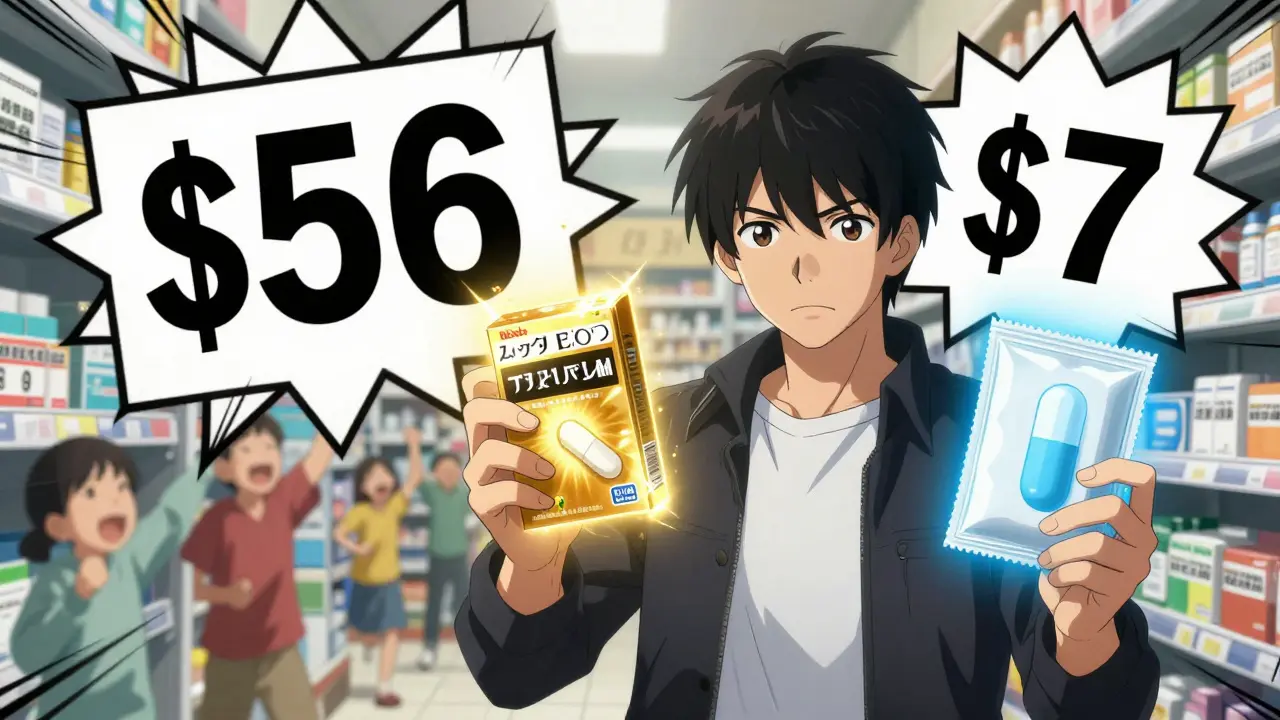
When you fill a prescription, you expect to pay a fair price. But what you actually pay often has little to do with what the drug costs to make. In the U.S., the difference between a brand-name drug and its generic version isn’t just about the label-it’s about whether you pay $7 or $56 for the same treatment. That’s not a typo. It’s the reality for millions of Americans every year.
How Much More Do Brand-Name Drugs Cost?
In 2023, the average out-of-pocket cost for a generic prescription was $7.05. For brand-name drugs? $27.10. That’s nearly four times more. Some cases are even worse. Take Sildenafil Citrate-the generic version of Viagra. When generics hit the market, the price per prescription dropped from $49.90 to just $3.07. A 94% drop. Emtricitabine/Tenofovir, used to treat HIV, fell from $20.46 to $2.13. That’s a 90% reduction.
These aren’t rare exceptions. They’re the rule. According to data from the FDA, when efavirenz, emtricitabine, and tenofovir lost patent protection, the 30-day cost for patients plunged from around $1,000 to $65. That single switch saved $131 million in just one year.
And yet, many people still pay full brand-name prices-even when generics are available. Why? Because pharmacy networks, insurance tiers, and opaque pricing systems make it hard to know what you’re really paying.
Generics Are Everywhere-But You’re Still Overpaying
Generics make up 90% of all prescriptions filled in the U.S. But they account for only 13.1% of total drug spending. That means for every 10 pills you take, 9 are cheap generics. But your wallet doesn’t always reflect that.
Here’s the problem: insurance plans often put generics on higher cost tiers. Instead of a $5 copay, you get stuck with a $20 or $30 coinsurance. One analysis found that when insurers moved generics to higher tiers, patient spending went up by 135%, even though drug prices overall dropped by 38%. That’s not a mistake-it’s a business model.
And it gets worse. Medicare Part D, the federal drug program for seniors, overspent by $2.6 billion in 2018 alone. Why? Because patients paid more than they would have at Costco. In fact, over half of all 90-day fills under Medicare cost more than the member price at Costco. Some people without insurance paid less than those with Medicare coverage.
Where Your Money Really Goes
When you pay $44 for Pantoprazole at Albertsons, but it’s $9.20 at a direct-to-consumer pharmacy, where’s the rest of your money going? Not to the manufacturer. Not to the pharmacist. It’s going to middlemen-pharmacy benefit managers (PBMs), insurers, and distributors-who control pricing behind the scenes.
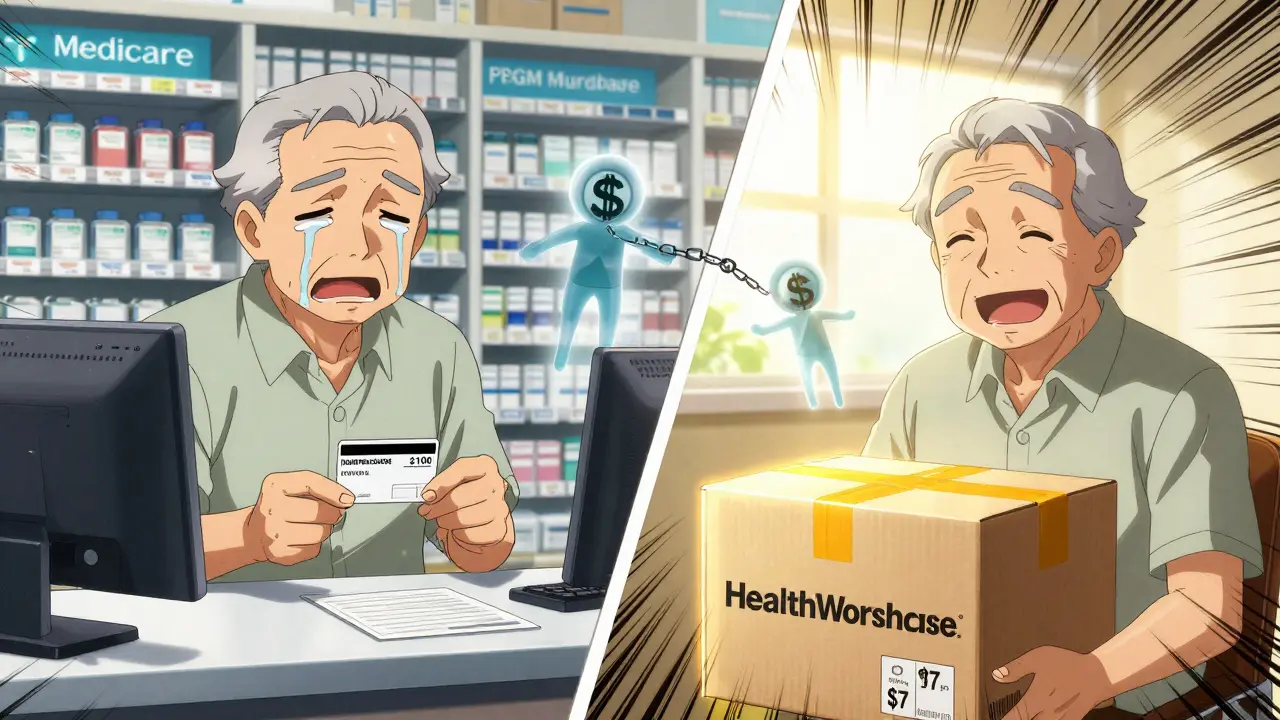
A 2023 NIH study found that DTC pharmacies cut generic drug costs by 75-76% on average. Rosuvastatin 5mg? $110 at Walgreens. $7.50 at Health Warehouse. That’s a 93% difference. The medication is identical. The pill is the same. The science is the same. But your price? Totally different.
This isn’t about quality. It’s about access. The USC Schaeffer Center found that patients overpay by 13-20% because of “lack of price transparency and supply chain inefficiencies.” In other words, the system is designed to hide the real cost. And you’re left guessing.
Why Do Generics Cost So Little?
The answer goes back to 1984 and the Hatch-Waxman Act. That law created a fast-track approval process for generic drugs. Companies didn’t have to repeat expensive clinical trials. They just had to prove their version worked the same as the brand-name drug. That cut development costs by 80-90%.
Since then, competition has driven prices down. When multiple generic manufacturers enter the market, prices tumble. In 2023, 93% of all generic prescriptions cost $20 or less. Over 82% were under $20. Nearly 99% were under $50.
That’s why the total value of U.S. generic sales has dropped by $6.4 billion since 2019-even as more people use them. The system is working: more prescriptions, lower prices. But your out-of-pocket cost? It doesn’t always match.
What You Can Do Right Now
You don’t have to accept overpaying. Here’s how to save:
- Ask for the generic-every time. Even if your doctor doesn’t suggest it, you can request it.
- Compare prices-use tools like GoodRx, SingleCare, or Blink Health. Prices vary wildly between pharmacies.
- Try mail-order or DTC pharmacies-companies like HealthWarehouse, MCCPDC, or Amazon Pharmacy often offer the same meds for 70-90% less than retail.
- Check if your plan uses 90-day fills-they’re cheaper per pill, but only if your pharmacy network doesn’t inflate the price.
- Ask about cash prices-sometimes paying out of pocket without insurance is cheaper than using your copay.
For example, Pantoprazole 20mg costs $44 at Albertsons. At MCCPDC? $9.20. That’s $34.80 saved per prescription. Do that four times a year? You’re saving over $140.
The Bigger Picture: Why This Still Happens
The U.S. spends nearly three times more on prescription drugs than other wealthy countries. Yet 9 out of 10 prescriptions here are for generics. That means the problem isn’t the drugs-it’s the system.
Pharmacy benefit managers negotiate rebates with drugmakers. But those rebates don’t go to you. They go to insurers and PBMs. So while the list price of a drug drops, your copay doesn’t. You’re paying for a system that rewards complexity over clarity.
And when patents expire on blockbuster drugs like Humira or Enbrel, the savings could hit billions. But if insurers keep putting generics on higher tiers, or pharmacies keep hiding prices, patients won’t see the benefit.
The good news? The trend is clear. Generics are cheaper. They’re safe. They’re everywhere. The bad news? The system is rigged to make you pay more than you should.
It’s not about not having insurance. It’s about not knowing how to navigate the maze. And once you do, you’ll realize how much you’ve been overpaying all along.
What’s Next for Drug Pricing?
More blockbuster drugs are losing patent protection in the next few years. Drugs like Ozempic, Humira, and Keytruda will have generic or biosimilar versions soon. That could mean massive savings-hundreds of billions over the next decade.
But without reform, those savings won’t reach patients. They’ll stay locked in the system: in rebates, in administrative fees, in pharmacy networks that charge more than they should.
The solution isn’t more regulation. It’s more transparency. If every pharmacy had to show the real cash price before you pay-if insurers had to pass savings directly to patients-then we wouldn’t need to fight for every dollar.
Right now, the system is broken. But you have more power than you think. Ask. Compare. Switch. You’re not just saving money-you’re forcing the system to change.
Are generic drugs as safe and effective as brand-name drugs?
Yes. The FDA requires generic drugs to have the same active ingredient, strength, dosage form, and route of administration as the brand-name version. They must also meet the same strict manufacturing standards. Studies show generics work just as well. In fact, 90% of prescriptions in the U.S. are for generics because they’re proven safe and effective.
Why do I pay more for a generic at my local pharmacy than online?
Retail pharmacies often charge higher prices because they’re tied to insurance networks that negotiate inflated prices with pharmacy benefit managers (PBMs). Online pharmacies, especially direct-to-consumer ones, bypass those middlemen. They buy in bulk, cut out unnecessary markups, and pass savings directly to you. The medication is identical-it’s just the pricing structure that’s different.
Can I switch to a generic if my doctor prescribed a brand-name drug?
Yes, unless your doctor specifically wrote "do not substitute" on the prescription. In most cases, pharmacists can substitute a generic unless the prescription says otherwise. Always ask your pharmacist: "Is there a generic version available?" If they say no, ask your doctor to confirm.
Why do some insurance plans make generics more expensive than brand-name drugs?
Some insurers put generics on higher cost tiers to push patients toward more expensive drugs that give them bigger rebates from drugmakers. It sounds backwards, but it’s common. PBMs profit more when patients use pricier drugs-even if cheaper generics exist. This is why checking your plan’s formulary and asking about cash prices is critical.
How much can I save by switching from brand-name to generic?
On average, patients save 80-90% by switching. For example, the brand-name drug Lipitor cost $110 per month in 2011. Its generic, atorvastatin, cost $12. That’s an 89% drop. In 2023, the average generic copay was $7.05 compared to $27.10 for brand-name drugs. That’s a 74% savings on average. For some drugs, like Sildenafil or Emtricitabine/Tenofovir, savings exceed 90%.
About Author

I just switched my blood pressure med to generic and saved $120 this month. Like, seriously? I was paying $50 at CVS. Same pill. Same box. Just a different label. I feel like I got scammed for years. Why does anyone still pay full price?!
The structural inequities in pharmaceutical pricing reveal a deeper epistemological crisis in American healthcare: we have commodified health itself. The Hatch-Waxman Act was a triumph of public policy, yet its benefits are systematically siphoned away by intermediaries who profit from opacity. The irony is profound-when patients are empowered with transparency, savings are not merely financial, but existential. We must demand that cost reductions be passed directly to the consumer, not absorbed into corporate balance sheets. This is not a market failure-it is a moral failure.
OMG I just realized I’ve been paying $80 for my diabetes meds at Walgreens 😭 Turned out HealthWarehouse had it for $6.50. I cried. Like, full-on ugly cry. My mom’s been doing this for years-she says ‘India taught me to shop smart.’ I’m so embarrassed I didn’t listen sooner. 🙈✨
Let’s be real-the system isn’t broken. It’s working exactly as designed. PBMs are the puppet masters. Insurers? They’re just the stage. You think you’re getting ‘coverage’? Nah. You’re a data point in a spreadsheet that calculates how much you’ll pay so they can extract maximum profit. The ‘generic’ label? A marketing trick to make you feel better while they still charge you for the brand. 😏
YESSSSS!! 😍 I use GoodRx ALL THE TIME!! Last week I saved $45 on my thyroid med-just by switching to a different pharmacy!! 🙌 And guess what? The pill looks EXACTLY the same!! I even took a pic to prove it to my pharmacist-he was like ‘huh, weird.’ So yeah, always ask, always compare, always switch!! 💪❤️
India makes 60% of the world’s generics. We don’t need American middlemen to sell us back our own medicine. If you’re paying $40 for a pill made in Hyderabad, you’re being robbed. Simple. The U.S. system is a scam built on ignorance. Learn from us-we’ve been saving lives with generics for decades. Stop overpaying. Start thinking globally.
Okay but have you seen the price of Omeprazole?? 😭 I went from $35 to $7.50. I almost fainted. I thought I was getting ripped off. Then I found out my neighbor was paying $3 at a warehouse. I screamed. My cat ran out of the room. I’m telling everyone. This is wild. I’m telling my boss. I’m telling my priest. I’m telling my dog. I’m telling strangers on the street. THIS IS A SCAM.
Love this breakdown. Seriously. I used to think generics were ‘second-tier.’ Then I started comparing labels side by side-same manufacturer, same batch code, same expiration. Just different packaging. It’s wild how much psychology plays into this. We’re trained to trust the brand. But the science? Totally equal. The system’s rigged, but the fix is simple: ask, check, switch. You’ve got this.
I’ve been using DTC pharmacies for a year now. It’s changed my life. I used to skip doses because I couldn’t afford them. Now I take them every day. I wish I’d known sooner. No one talks about this. It’s like we’re all supposed to just suffer quietly. But you don’t have to. Just... ask. It’s okay to ask.
Wow. So the U.S. spends 3x more than other countries... on generics. Right. And I’m supposed to believe this is ‘innovation’? 😂 I think the real drug here is capitalism. You take a pill made in India, slap on a U.S. label, and suddenly it’s ‘premium.’ I’d like to see how this works in a country where people aren’t expected to be financial detectives just to stay alive.
Actually, the data is misleading. The FDA’s equivalence standards are not as rigorous as they claim. While generics must have the same active ingredient, they can differ in fillers, binders, and coatings-which can affect absorption. I’ve personally had two patients experience adverse effects after switching. One had a seizure. Another had severe nausea. The FDA doesn’t require bioequivalence testing for all formulations. So yes, 90% work fine. But 10%? That’s not a glitch. It’s a risk. And no one’s talking about it.
They’re putting microchips in the generics. Seriously. I read it on a forum. The PBMs track your usage. Then they sell your data to insurance companies. They know when you refill. They know when you skip. Then they raise your premiums. It’s all connected. The cheap price? It’s a trap. You think you’re saving? You’re being watched. And your doctor? They’re in on it. They get kickbacks. Don’t trust anything.
Did you know the government secretly owns the patents on most generics? 😳 They’re not letting you know because they’re making billions off the system. I saw a leaked memo. It says ‘maintain consumer dependency.’ That’s why they make it so confusing. It’s not about profit. It’s about control. The pills are fine. The system? It’s a cult. 🕯️