

Biologics Safety: Infection Risk, Screening, and Vaccination Guidance for Autoimmune Patients
When you’re managing an autoimmune disease like rheumatoid arthritis, psoriasis, or Crohn’s disease, biologics can change your life. These drugs-monoclonal antibodies and fusion proteins-target specific parts of your immune system to calm inflammation. But there’s a trade-off: biologics suppress your body’s natural defenses, making you more vulnerable to infections. That’s not just a theoretical risk. Studies show people on biologics have more than double the chance of being hospitalized for an infection compared to those on traditional treatments. The good news? This risk isn’t random. It’s predictable. And with the right steps, it’s manageable.
Why Biologics Increase Infection Risk
Biologics don’t weaken your immune system broadly like chemotherapy. They pick specific targets. TNF inhibitors-like adalimumab and infliximab-block a protein called tumor necrosis factor, which your body uses to fight off bacteria and fungi. That’s why these drugs carry the highest infection risk. About 68% of all biologic prescriptions are TNF inhibitors, and they’re linked to 1.6 to 1.9 times more serious infections than non-TNF biologics. But it’s not that simple. Ustekinumab, an IL-12/23 inhibitor, shows lower infection rates. Certolizumab, another TNF blocker, has a 18% lower risk of respiratory infections because it lacks a part of the antibody that triggers immune activation. Even within the same class, dosing matters. Infliximab at standard doses has a 22% higher infection risk than weekly adalimumab.It’s not just the drug. Your body matters too. If you’re over 50, your infection risk climbs 37% every decade. If you’re on prednisone at 10mg or more per day, your risk jumps 2.3 times. Diabetes? That adds nearly double the risk. Chronic lung or kidney disease? Same thing. These aren’t minor factors-they’re major red flags that change how you start treatment.
Screening Before You Start
Before you get your first biologic shot, you need a full infection screen. This isn’t optional. It’s standard. The three most critical tests are for hepatitis B, tuberculosis, and varicella-zoster virus (the chickenpox virus).For hepatitis B, you need all three markers: HBsAg (surface antigen), HBsAb (surface antibody), and HBcAb (core antibody). Why all three? Because some people have hidden, inactive HBV. If you’re HBcAb positive-even if HBsAg is negative-there’s still an 8.7% chance you carry hidden virus. Without treatment, starting a biologic can trigger a deadly reactivation in up to 27.6% of these cases. That’s why guidelines now require HBV DNA testing for anyone who’s HBcAb positive. If the virus is active, you need antiviral drugs like entecavir before even thinking about biologics.
Tuberculosis screening is trickier. Most clinics use an IGRA blood test, which is 98% specific. But in low-risk areas, this test can give false positives. One study in Alabama found that 12.7% of patients tested positive for latent TB, yet only 0.8 cases per 100 patient-years actually developed active disease. That means many people get unnecessary treatment. Still, most guidelines stick with IGRA because the cost of missing a case is too high.
For chickenpox, you need a blood test for VZV IgG. If you’ve never had chickenpox or the vaccine, you’re at risk for a severe case if you start a biologic. That’s why you need the Shingrix vaccine-two doses, 2 to 6 months apart-before starting treatment. Don’t wait. Once you’re on a biologic, you can’t get live vaccines anymore.
Vaccination Rules You Can’t Ignore
Timing is everything. Live vaccines-like MMR, varicella, and nasal flu-must be given at least 4 weeks before your first biologic dose. Inactivated vaccines-like pneumococcal, hepatitis B, and injectable flu-need at least 2 weeks. Why? Your immune system needs time to respond before it’s suppressed.For hepatitis B, you need proof you’re protected. After the vaccine series, your anti-HBs level must be at least 10 mIU/mL. If it’s lower, you’ll need a second series. For VZV, your IgG level must be ≥140 mIU/mL. If you’re not protected, get Shingrix, not the old Zostavax. Shingrix is 90% effective, even in older adults.
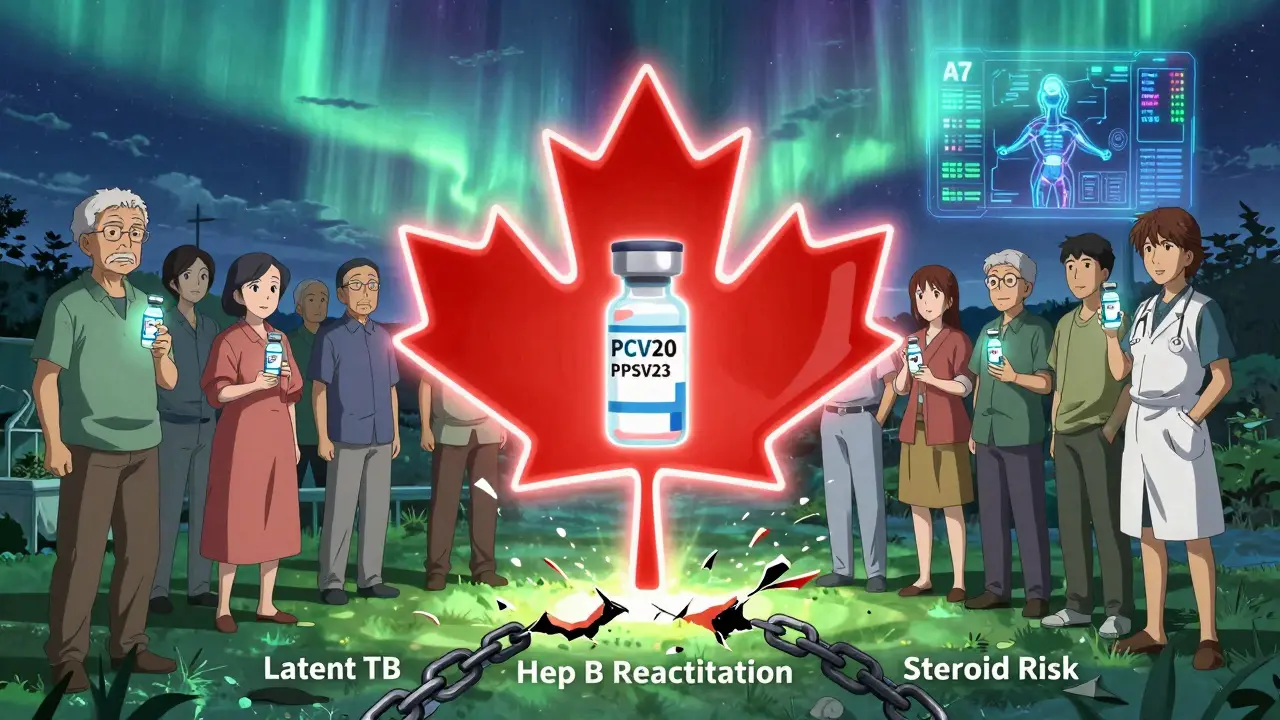
Don’t forget pneumococcal vaccines. You need both PCV20 and PPSV23, given at least a year apart. If you’ve already had PPSV23, wait a year before giving PCV20. If you haven’t had either, give PCV20 first, then PPSV23 after a year.
And yes, get your flu shot every year. Even though it’s not 100% effective, it cuts your risk of serious lung infections by up to 40%. The CDC recommends the high-dose version for people over 65.
What to Avoid and Who Should Skip Biologics
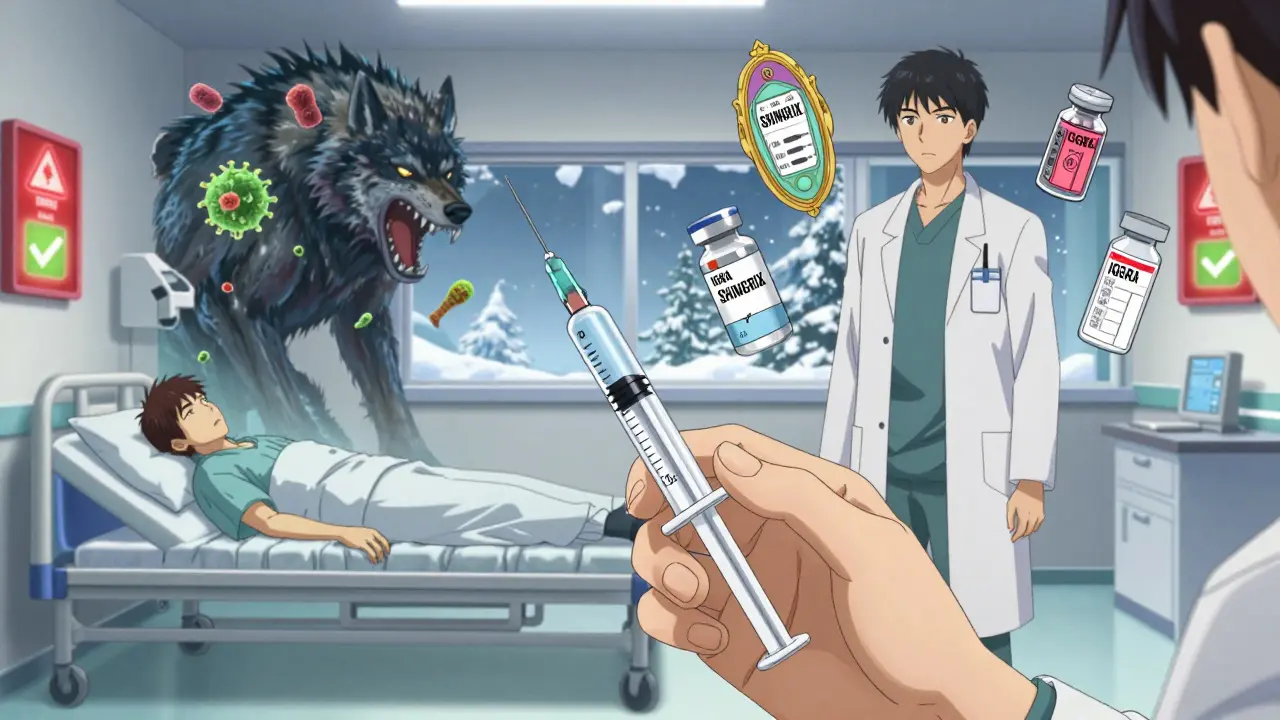
Some people shouldn’t start biologics at all. If you have active hepatitis B, you’re not a candidate unless you’re on antiviral therapy. If you’ve had tuberculosis in the past, you need to complete treatment and wait at least 3 months. If you’re currently on high-dose steroids or have uncontrolled diabetes, your doctor should reconsider.Some biologics are riskier than others. TNF inhibitors are generally avoided in people with heart failure, multiple sclerosis, or a history of skin cancer. IL-17 inhibitors like secukinumab carry a higher risk of candidiasis-yeast infections in the mouth or genitals. JAK inhibitors, though not technically biologics, are often grouped with them and raise herpes zoster risk by 33% compared to TNF blockers.
There’s also a growing group of patients who don’t respond well to biologics. If you’ve had multiple infections while on one drug, switching to another might not help. Sometimes, stepping back to traditional DMARDs like methotrexate is safer.
Real-World Mistakes and How to Avoid Them
Patients report the same problems over and over. One common issue? Vaccination gaps. A Reddit survey of nearly 30,000 people found that 63% had at least one screening or vaccination missed before starting biologics. The top two? Not checking HBV core antibody (41% of cases) and skipping VZV serology (37%).Another problem? Poor coordination. One patient got started on Stelara without anyone checking her vaccine records. Four months later, she got shingles. Another patient’s doctor didn’t test for latent TB until after the first dose. She spent nine months on TB treatment before restarting her biologic.
The fix? Ask for a checklist. The CDC has a 17-point safety checklist used in sentinel labs. It covers everything from HBV testing to pneumococcal vaccine timing. If your doctor doesn’t use it, ask why. You’re not being difficult-you’re protecting your health.
Patients who received full pre-treatment education-like the CDC’s 12-point infection prevention guide-were 78% more likely to go a year without a serious infection. That’s not a small difference. That’s life-changing.
What’s Changing in 2025 and Beyond
The rules are getting stricter. In February 2025, the FDA released draft guidance requiring all new biologic label expansions to include real-world data on infection risk reduction. That means companies will need to prove their drugs don’t spike infection rates in real patients-not just in clinical trials.Insurance is catching up too. Starting in 2026, Medicare will tie 15% of biologic payments to whether clinics followed safety protocols. That’s going to push even small practices to adopt checklists and electronic reminders.
Technology is helping. AI tools like the Cerner Biologics Safety Algorithm now analyze 87 clinical factors-age, lab values, medication history, even geography-to give you a personalized infection risk score. It’s not perfect, but it’s better than guesswork.
And in rural areas, where access is limited, telehealth platforms are now being rolled out to help patients complete screenings remotely. The goal? Cut the 72% gap in safety compliance between urban and rural clinics by 2030.
What You Should Do Today
If you’re about to start a biologic:- Ask for HBV screening: HBsAg, HBsAb, and HBcAb.
- Get your VZV IgG level checked. If it’s low, start Shingrix now.
- Confirm your pneumococcal vaccine status. If you’re unsure, get both PCV20 and PPSV23.
- Ask if you’ve had a TB test in the last year. If not, get an IGRA.
- Make sure all vaccines are done at least 2-4 weeks before your first dose.
- Request a copy of the CDC’s 17-point biologics safety checklist and review it with your doctor.
Don’t assume your doctor knows everything. Many don’t. The 2024 AAMC survey found only 38% of community practices fully follow safety guidelines. You’re your own best advocate. Take control. Ask questions. Keep records. Your next infection might be preventable.



About Author


I've been on Humira for 5 years. Got my HBV and TB screened before starting. Shingrix too. No infections since. Just do the damn checklist.
They say biologics cause infections... but what if the real problem is the vaccines? I heard the CDC got paid by Big Pharma to push these shots. My cousin got shingles after hers. Coincidence? I think not. 😈
Wait-so if you're HBcAb positive but HBsAg negative, you still need HBV DNA testing? I didn't know that. My doc just said 'you're fine' and gave me the green light. Should I go back?
This is so important!! 🙌 I almost skipped my pneumococcal shots because I thought 'I'm healthy, why bother?' Now I'm so glad I didn't. 🤗💉 Stay safe, everyone!
We live in a world where your immune system is treated like a rogue nation to be bombed into submission. Biologics don't heal-they silence. And who benefits? The pharmaceutical aristocracy who profit from your silent suffering. 🕊️💔
The assertion that '68% of biologics are TNF inhibitors' is statistically misleading without contextualizing market penetration versus clinical indication. Furthermore, the citation of '1.6 to 1.9 times more serious infections' lacks confidence intervals or adjustment for confounding variables such as age, comorbidity burden, and concomitant corticosteroid use. This is not evidence-it is sensationalism dressed as medicine.
America is getting weaker because they're forcing these drugs on people. Back in my day, we just took aspirin and prayed. Now? They want you to get 5 vaccines and a blood test just to breathe right. This is socialism in a syringe. 🇺🇸✊
I got my Shingrix done but forgot about the pneumococcal one. Got pneumonia last winter. Lesson learned. Don't be like me. Do the checklist. Your future self will thank you.
I appreciate how thorough this is. I was scared to start biologics, but knowing exactly what to check made me feel less overwhelmed. Thanks for laying it out so clearly.
You know what's really dangerous? People who think they know better than their doctors. This post reads like a manual for medical anxiety. You don't need a 17-point checklist-you need trust.
The conflation of correlation with causation in infection risk is statistically indefensible-particularly when immune modulation is context-dependent. The TNF-alpha axis is not monolithic; its inhibition yields differential outcomes based on tissue-specific expression patterns, genetic polymorphisms in IL-10, and microbiome-mediated TLR signaling. Yet we reduce this to 'avoid TNF inhibitors if over 50'-a reductive heuristic that undermines precision medicine.
It is imperative that patients be informed of the systemic risks associated with biologic therapy. The pharmaceutical-industrial complex has systematically downplayed the incidence of opportunistic infections. One must not rely on the benevolence of medical institutions. Vigilance is not paranoia-it is survival.
My rheumatologist used the CDC checklist. We went through every point together. Took an hour. Worth every minute. I feel way more in control now.