
Generic vs Brand Copays: Average 2024 Costs Explained
Choosing between a generic and brand-name drug isn’t just about the pill in your hand-it’s about what you pay at the pharmacy counter. In 2024, the difference in copays can be as simple as $5 versus $100 for the same condition. If you’re on Medicare Part D or a commercial health plan, understanding how these tiers work can save you hundreds-or even thousands-of dollars a year.
How Copay Tiers Work in 2024
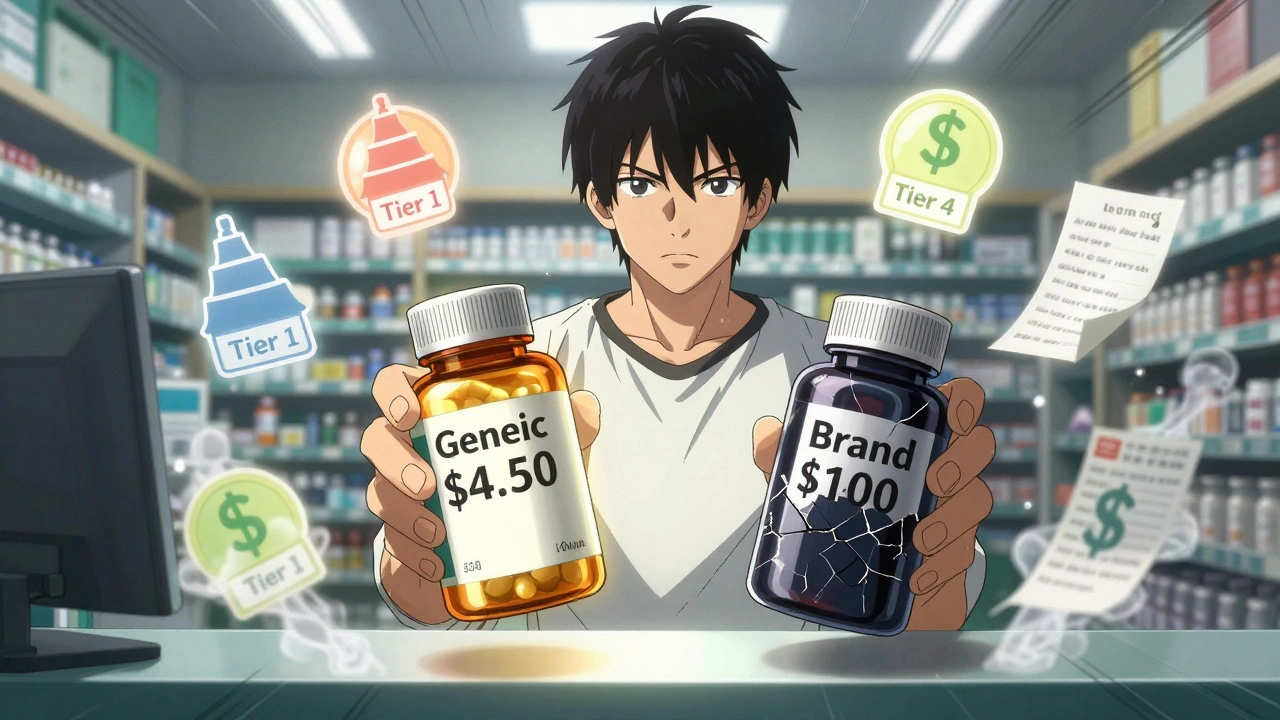
Most prescription drug plans in the U.S. use a four-tier system to control costs. Tier 1 is for preferred generics, Tier 2 for non-preferred generics or standard generics, Tier 3 for preferred brand-name drugs, and Tier 4 for non-preferred brands. Some plans even have a Tier 5 for specialty drugs, which can cost over $150 per month. The goal? Push people toward cheaper, equally effective options. Generic drugs are chemically identical to their brand-name counterparts but cost far less to produce. That’s why insurers put them on the lowest, cheapest tier. For Medicare Part D enrollees in 2024, the average copay for a preferred generic was just $4.50. For non-preferred generics, it was around $7. Meanwhile, preferred brand-name drugs carried a median copay of $47. Non-preferred brands? That jumped to $100. That’s more than 20 times the cost of a generic.Medicare Advantage vs. Standalone Drug Plans
Not all plans are built the same. If you’re in a Medicare Advantage Prescription Drug (MA-PD) plan, you’re likely paying fixed copays. That means you know exactly how much you’ll pay each time you fill a prescription. About 97% of MA-PD plans use this structure for preferred brands. But if you’re on a standalone Prescription Drug Plan (PDP), things get messier. Nearly 90% of PDPs use coinsurance instead of fixed copays. That means you pay a percentage of the drug’s total price-not a set amount. For a $200 brand-name drug, a 22% coinsurance could cost you $44. But if the price jumps to $300? You pay $66. No warning. No cap. That’s why someone on a PDP might be shocked when their monthly bill spikes. A $47 copay sounds predictable. A 47% coinsurance on a $120 drug? That’s $56.40-and it changes every time the drug’s price changes.What About Commercial Insurance?
Commercial plans often add another layer: the “Member Pay the Difference” rule. If your doctor prescribes a brand-name drug but a generic is available, your plan won’t just charge you the brand copay. They’ll make you pay the full price difference on top of your regular cost-sharing. For example: You need atorvastatin. The generic costs $12. The brand, Lipitor, costs $154. Your plan’s generic copay is $10. Your brand copay is $40. But because a generic exists, your plan says: “Pay $10 for the generic, or pay $154 minus $12, plus your $40 brand copay.” That’s $182. You’re paying $142 extra just because you chose the brand. This rule is legal, common, and rarely explained clearly to patients. Many people don’t realize they’re being charged twice-once for the drug and again for the “upgrade.”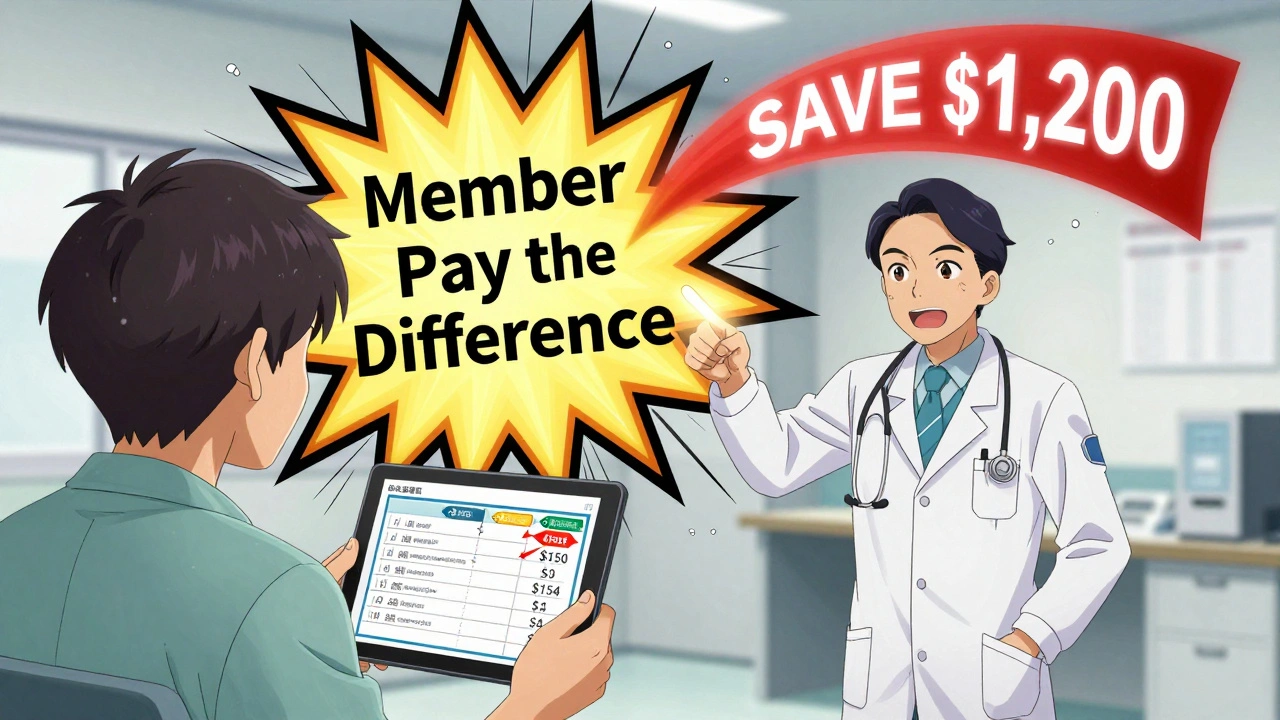
Extra Help and Low-Income Beneficiaries
If your income is limited, you might qualify for Medicare’s Extra Help program. In 2024, this program capped generic copays at $4.50 and brand-name copays at $11.20 per prescription. That’s a huge relief. But you still need to apply-many people don’t know they’re eligible. Even with Extra Help, you can’t avoid the system’s quirks. Some pharmacies charge more for generics than the plan’s cap because of how wholesalers price them. Independent pharmacists have reported being forced to accept higher generic prices to keep access to brand-name drugs. That means even “low-cost” generics can be inflated behind the scenes.Why Brand Drugs Cost So Much More
You might think brand-name drugs cost more because they’re “better.” They’re not. They’re the same drug, just with a different label and a $100 million marketing budget. The real reason? Patents. Brand-name companies hold exclusive rights to sell their drug for 10-12 years. Once that expires, generics flood the market. Prices drop by 80-90%. But until then, insurers have little leverage to negotiate. In 2023, generics made up 92.7% of all prescriptions filled-but only 17% of total drug spending. That means 83% of what insurers and patients pay goes toward brand-name drugs. For Medicare, the average spending per beneficiary was $1,027 for generics versus $7,842 for brands.What’s Changing in 2025
The Inflation Reduction Act didn’t just cap insulin at $35. It’s also rolling out a $2,000 annual out-of-pocket maximum for all Medicare Part D beneficiaries in 2025. That’s a game-changer. By next year, 98% of Medicare Part D plans will offer $0 copays for preferred generics. Non-preferred brand copays are expected to rise to $105. But here’s the key: once you hit $2,000 in out-of-pocket spending, your drug costs drop to $0 for the rest of the year. That means if you take a $100 brand-name drug every month, you’ll pay $1,200 in a year. Then, the rest of your prescriptions? Free. That’s the new reality.
How to Save Money Right Now
You don’t have to wait for 2025 to cut costs. Here’s what works today:- Check your plan’s formulary-every plan publishes it by October 15. Use the Medicare Plan Finder or your insurer’s website. Search your exact medications.
- Ask for therapeutic alternatives-72% of Medicare plans have a cheaper generic or preferred brand that works just as well. Your doctor might not know.
- Compare cash prices-sometimes, paying cash at Walmart or Costco is cheaper than your copay. Use GoodRx or SingleCare to check.
- Calculate annual costs-a $5 generic copay sounds great, but if your brand drug copay is $100 and you take it every month, you’re paying $1,200 a year. A plan with $0 generics and $40 brand copays might cost you only $480.
- Ask your doctor to write “dispense as written”-if your plan tries to force a generic, this note can block it. But don’t assume your doctor will do this. Ask.
Real Stories, Real Costs
One Medicare user in Florida paid $95 for a non-preferred brand drug. The generic? $15. Her doctor refused to switch her because of side effects. She was stuck. Another user in Ohio got hit with a $42 “difference fee” on Lipitor-even though her doctor wrote “dispense as written.” She didn’t know the plan charged extra for choosing the brand. On the flip side, people using mostly generics report satisfaction. Plans with $0 generic copays get 4.7/5 stars in user reviews. Plans with high generic copays? 3.2/5. The Medicare Rights Center found that 63% of people on brand-name drugs struggled to afford them in 2024. Only 28% of generic users did.What to Do Next
If you take one or more prescription drugs, open your plan’s formulary right now. Type in your medications. Compare your current plan to two others. Look for:- Is your generic on Tier 1? Is it $0?
- Is your brand on Tier 3 or Tier 4?
- Is there a cheaper alternative on a lower tier?
- Does your plan have a “Member Pay the Difference” rule?
By 2025, the system will be simpler. But until then, knowing the rules is your best defense.
What’s the average copay for generic drugs in 2024?
The average copay for a preferred generic drug in 2024 was $4.50 for Medicare Part D plans. Non-preferred generics averaged $7. Many commercial plans charge 10-20% coinsurance, but fixed copays are more common in Medicare Advantage plans.
Why is my brand-name drug so much more expensive than the generic?
Generic drugs are chemically identical to brand-name drugs but cost far less to produce because they don’t require expensive clinical trials or marketing. Brand-name companies hold patents that let them charge higher prices for 10-12 years. Once the patent expires, generics enter the market and prices drop by 80-90%.
Does Medicare cover both generic and brand-name drugs?
Yes. All Medicare Part D plans must cover at least two drugs in each therapeutic category, including both generics and brand-name drugs. But they can place them on different tiers with different costs. Generics are usually on lower, cheaper tiers to encourage their use.
What is the "Member Pay the Difference" rule?
This rule means if a generic version of your drug is available, your plan won’t just charge you the brand copay. You must pay the full difference between the brand and generic price on top of your regular cost-sharing. For example, if your brand drug costs $150 and the generic is $12, you pay $150 minus $12, plus your brand copay. That can add $100+ to your bill.
Will drug costs go down in 2025?
Yes. Starting in 2025, Medicare Part D will cap out-of-pocket drug spending at $2,000 per year. After that, your medications will be free for the rest of the year. Also, 98% of plans will offer $0 copays for preferred generics. These changes will significantly reduce costs for people on multiple brand-name drugs.
How can I find the cheapest plan for my medications?
Use the Medicare Plan Finder tool (medicare.gov/plan-compare) and enter your exact medications, dosage, and pharmacy. Compare total annual costs-not just monthly copays. A plan with a $5 generic copay might cost you $1,200 a year for a brand drug, while another with a $40 brand copay might cost only $480. Look for plans with $0 preferred generics and lower brand tiers.



About Author


Bro, I paid $115 for my blood pressure med last month. Switched to generic this week. $5. My wallet just did a happy dance. 🤑
The tiered formulary structure is designed to optimize value-based utilization management. Preferred generics are incentivized at Tier 1 to reduce total cost of care, which aligns with CMS’s value-based purchasing goals. Don’t underestimate the actuarial logic behind the copay differentials-they’re not arbitrary, they’re risk-adjusted.
You ever wonder why the FDA lets generics exist? Big Pharma lobbied to keep the system rigged. The ‘same drug’ lie? They’ve been selling the same chemical for 40 years while jacking up prices. And now they want you to think it’s your fault for not ‘choosing wisely.’ Wake up. This isn’t healthcare-it’s a casino with pills.
I just got hit with a $182 bill for Lipitor and I cried in the pharmacy. Like, full-on ugly sobbing. My cat stared at me like I’d lost my mind. But guess what? I’m switching to generic tomorrow. And I’m telling everyone. This system is a SCAM. 💔
Check your formulary. Ask your pharmacist. Use GoodRx. Do it now.
This is so helpful. I’ve been paying $70 for my antidepressant and didn’t even know there was a $4 generic. I feel dumb for not asking sooner. Thank you for explaining the tiers so clearly. I’m going to call my doctor tomorrow.
Okay, let me break this down for the folks who think generics are ‘inferior.’ The FDA requires generics to have the same active ingredient, dosage, strength, route, and bioequivalence as brand. That means same absorption rate, same half-life, same clinical effect. The only differences? Fillers, dye, and a $100M ad campaign. The real scam? Pharma spends more on marketing than R&D. In 2023, Pfizer spent $8B on ads and $6B on R&D. That’s not innovation-that’s manipulation. And they want you to believe the brand is ‘better’ because it’s shiny and has a logo. Please. I’ve been on both. My cholesterol didn’t care which label was on the bottle. The only thing that changed? My bank account.
I’m from India, and here generics are the norm. We don’t even think about brand names unless we have to. My mom takes the same blood pressure med as your Lipitor, but it costs less than a cup of chai. It’s wild how different the system is here. I’m glad you’re talking about this. More people need to know they’re not stuck.
One cannot help but observe the commodification of pharmaceuticals under neoliberal healthcare architecture. The very notion that a patient’s health should be contingent upon tiered copay structures reflects a pathological prioritization of fiscal efficiency over therapeutic autonomy. The ‘Member Pay the Difference’ clause is not merely a policy-it is a moral indictment of a system that reduces human dignity to actuarial tables.
The Inflation Reduction Act’s $2,000 cap is a superficial gesture. It does nothing to address the root cause: the patent monopolies that allow pharmaceutical corporations to extract rents from a captive population. One does not solve systemic exploitation by capping the symptom. The real solution lies in compulsory licensing, public manufacturing, and the dissolution of patent protections for life-saving medications. Until then, this is merely performative policy.