
Kidney Function Tests Explained: Creatinine, GFR, and Urinalysis
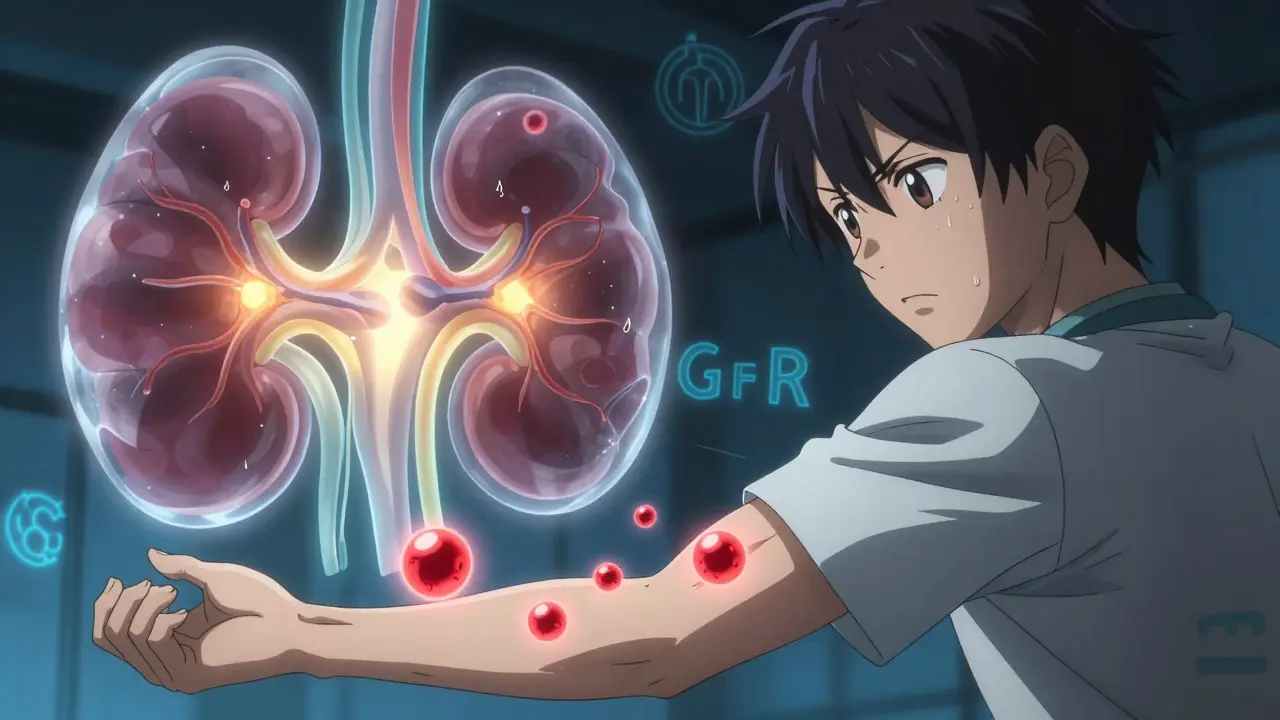
Most people don’t think about their kidneys until something goes wrong. But your kidneys are working 24/7-filtering waste, balancing fluids, and keeping your blood pressure in check. The problem? Kidney disease often has no symptoms until it’s advanced. That’s why simple blood and urine tests can be lifesavers. Three key tests-creatinine, GFR, and urinalysis-are the foundation of kidney health checks. They’re not complicated, but understanding them helps you catch problems early.
What Creatinine Tells You About Your Kidneys
Creatinine is a waste product your muscles make as they break down energy. Healthy kidneys filter it out of your blood and send it out in your urine. When kidney function drops, creatinine builds up in your bloodstream. That’s why doctors measure it in blood tests.
But here’s the catch: creatinine doesn’t rise until you’ve lost about half your kidney function. That makes it a late warning sign. A person with 40% kidney function might still have a "normal" creatinine level. That’s why creatinine alone isn’t enough-it’s just the first clue.
Normal creatinine levels vary by age, sex, and muscle mass. For adult men, it’s usually 0.7 to 1.3 mg/dL. For women, it’s 0.6 to 1.1 mg/dL. But if you’re very muscular or very elderly, your numbers might look off even if your kidneys are fine. That’s why doctors don’t rely on creatinine by itself.
What GFR Really Means (And Why It Matters More Than Creatinine)
Glomerular Filtration Rate, or GFR, is the gold standard for measuring how well your kidneys are filtering blood. It’s not directly measured-it’s calculated using your creatinine level, age, sex, and sometimes race. The most accurate formula used today is the CKD-EPI equation, which replaced the older MDRD method in 2012.
GFR is measured in milliliters per minute per 1.73 square meters of body surface area. Think of it as your kidney’s filtration speed. A GFR of 90 or above is normal. But here’s how the stages break down:
- Stage 1: GFR 90+ - Kidneys are working normally, but there may be early damage (like protein in urine)
- Stage 2: GFR 60-89 - Mild decrease in function
- Stage 3a: GFR 45-59 - Mild to moderate loss
- Stage 3b: GFR 30-44 - Moderate to severe loss
- Stage 4: GFR 15-29 - Severe loss
- Stage 5: GFR under 15 - Kidney failure
Doctors use GFR to track progression over time. If your GFR drops by more than 5 points in a year, it’s a red flag. But GFR isn’t perfect. It can be misleading if you’re under 18, pregnant, extremely muscular, or very overweight. In those cases, a cystatin C test might be used instead. Cystatin C is another blood marker that’s less affected by muscle mass and gives a clearer picture of kidney function.
Urinalysis: The Silent Early Warning System
While creatinine and GFR tell you how well your kidneys are filtering, urinalysis tells you what’s leaking out. The most important part of this test is checking for albumin-a type of protein that shouldn’t be in your urine.
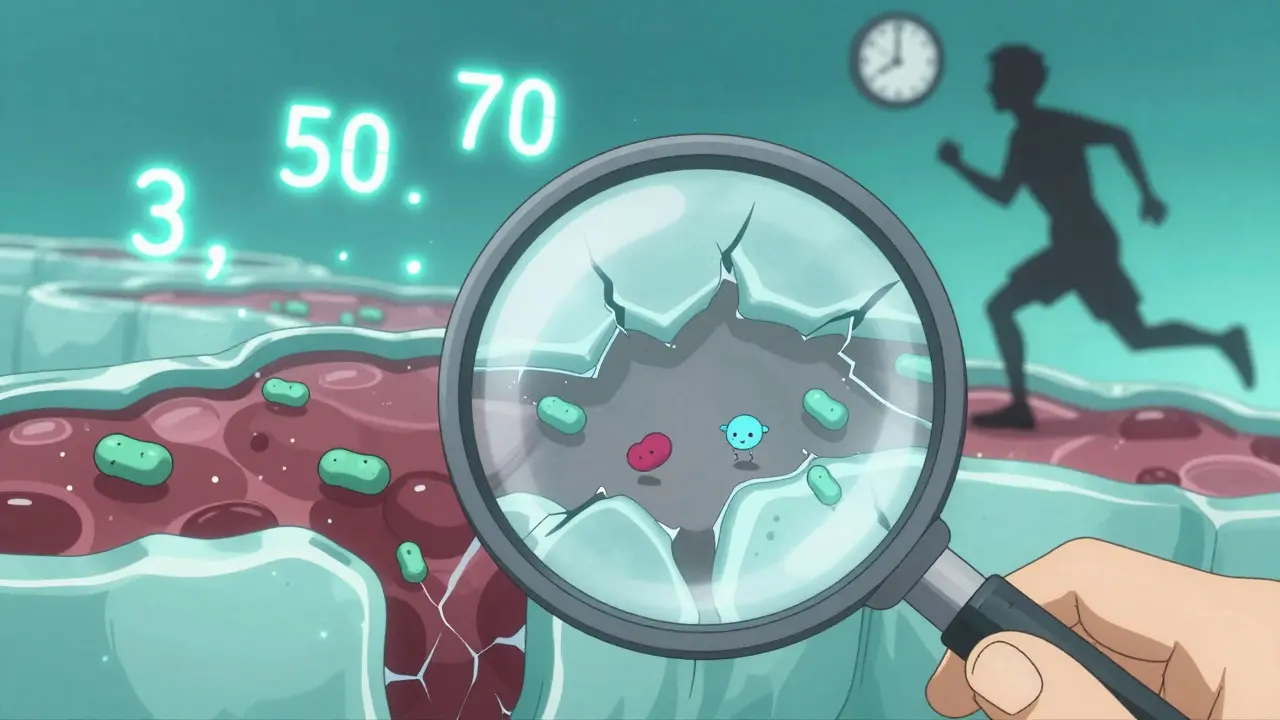
When your kidneys are damaged, tiny holes form in their filters. Albumin slips through, showing up in your urine long before creatinine rises. That’s why protein in urine is one of the earliest signs of kidney disease, even if your blood tests look normal.
Doctors don’t use old-fashioned dipstick tests anymore. Instead, they use the Albumin-to-Creatinine Ratio (ACR). This test measures how much albumin is in your urine compared to creatinine. A normal ACR is under 3 mg/mmol. If it’s between 3 and 70, it’s considered early kidney damage. Above 70 means more serious damage.
One abnormal ACR result isn’t enough. You need two out of three positive tests over 3-6 months to confirm kidney disease. This avoids false positives from things like dehydration, intense exercise, or a fever.
Why You Need Both Blood and Urine Tests
Some people think if their creatinine and GFR are normal, they’re fine. But that’s not true. You can have normal kidney function and still have early damage-shown only by protein in your urine.
Conversely, someone with low GFR might not have proteinuria if their damage is from high blood pressure alone, not from kidney disease itself. That’s why both tests are required. The UK Kidney Association and the National Kidney Foundation both say: always check both eGFR and ACR together.
For example, a 60-year-old with type 2 diabetes might have a GFR of 70 (mildly reduced) but an ACR of 50. That combination means they have diabetic kidney disease-even though their GFR hasn’t dropped into the danger zone yet. Catching it here lets them change their diet, start a new medication, or control blood sugar better to slow the damage.
Who Should Get Tested and How Often
You don’t need to be sick to get tested. If you fall into any of these groups, you should get checked at least once a year:
- Diabetes (type 1 or type 2)
- High blood pressure
- Heart disease
- Obesity
- Family history of kidney failure
- Age 60 or older
- Previous episode of acute kidney injury
The CDC recommends everyone get a basic metabolic panel (which includes creatinine) once a year as part of a routine checkup. If you’re in a high-risk group, you also need the ACR test. Some clinics now do both tests automatically for patients with diabetes or hypertension.
If you’ve been diagnosed with early kidney disease (Stage 1 or 2), you’ll likely be tested every 6 to 12 months. If you’re in Stage 3 or higher, your doctor may want to see you every 3 to 6 months.

What Happens If Your Results Are Abnormal
If your creatinine is high or your GFR is low, your doctor won’t panic right away. They’ll check for other causes-dehydration, certain medications (like NSAIDs), or a recent infection. They might repeat the test in a few weeks.
If your ACR is high, they’ll likely ask for a morning urine sample to confirm. They’ll also check your blood pressure and maybe order an ultrasound to see if your kidneys look normal on imaging.
If kidney disease is confirmed, treatment focuses on slowing progression. That means:
- Controlling blood pressure (target is usually under 130/80)
- Managing blood sugar if you have diabetes
- Switching from NSAIDs to safer pain relievers
- Reducing salt and protein intake
- Starting an SGLT2 inhibitor or ACE inhibitor, which protect kidneys even in people without diabetes
Many people with early kidney disease never progress to dialysis. With the right care, they live full lives.
Common Myths About Kidney Tests
Myth: "I feel fine, so my kidneys must be okay." Reality: Kidney disease is silent until it’s advanced. Feeling fine doesn’t mean your kidneys are healthy.
Myth: "Only people with diabetes need kidney tests." Reality: High blood pressure is actually the second leading cause of kidney failure. Anyone with hypertension should be tested.
Myth: "A normal creatinine means I’m fine." Reality: Creatinine misses early damage. You need the ACR test to catch it.
Myth: "I have to collect urine for 24 hours." Reality: For most people, a single morning urine sample is enough for ACR. The 24-hour collection is only used in special cases.
What’s the difference between GFR and creatinine?
Creatinine is a substance measured in your blood. GFR is a calculated number that estimates how well your kidneys filter waste. Creatinine tells you something is off; GFR tells you how bad it is.
Can I check my kidney function at home?
No reliable home tests exist for GFR or ACR. Some urine dipstick kits are sold online, but they’re not accurate enough for diagnosis. Always get tested through a lab or clinic.
Does drinking more water improve my GFR?
Drinking water won’t raise your GFR if your kidneys are damaged. But staying hydrated helps them work better. Dehydration can make GFR drop temporarily, which is why doctors ask you to avoid extreme fluid loss before testing.
Why does race matter in GFR calculations?
Older GFR formulas added a "race correction" for Black patients, assuming higher muscle mass. But recent research shows this isn’t reliable and can delay diagnosis. Many labs now use race-neutral formulas. Ask your doctor which one they use.
What if my ACR is high but my GFR is normal?
That’s called early kidney disease. It means your filters are leaking protein, even though your kidneys are still filtering waste well. This is the best time to act-medications and lifestyle changes can often stop the damage from getting worse.


About Author



Creatinine is just a number your doctor uses to feel smart
Real health isn't in labs it's in how you live
Stop chasing numbers and start eating real food
i got my a1c and creatinine done last week and my doc was like oh ur fine
but my acr was 45 and now im scared as hell
why didnt they tell me sooner
Did you know the pharmaceutical industry pays labs to use outdated GFR formulas so they can sell more drugs?
They dont want you to know that kidney damage can be reversed with fasting and turmeric
They profit from dialysis machines and kidney transplants
They even suppress studies showing that vitamin D3 restores glomerular function
And dont get me started on the salt lobby pushing sodium chloride into every processed food
The CDC is complicit
The FDA is bought
And your doctor? He's just another cog in the machine
Ask your lab which equation they use
And if they say CKD-EPI with race correction
Run
Run far away
For the record: ACR >3 is a red flag. Not a crisis.
But also: No, drinking more water won't fix your GFR if your filters are shredded.
And yes, race-neutral formulas are better. We're finally catching up.
Also: SGLT2 inhibitors are miracle drugs. They're not just for diabetics anymore.
Stop Googling 'natural kidney cures' and talk to your nephrologist.
:-)
My dad had Stage 3a last year. We changed his diet, cut the salt, started walking 45 mins a day.
His ACR dropped from 58 to 12 in 8 months.
It's not magic. It's discipline.
You don't need a miracle. You just need to show up.
And if you're scared? Good. That means you're awake.
Now go make a plan.
Western medicine is a fraud. In India, we have known for centuries that kidney health is tied to spiritual purity and proper fasting.
These blood tests are a colonial invention.
Why do you trust a formula designed by white men in America?
Our ancestors used neem leaves and cow urine.
Modern science is arrogant.
And you are being manipulated.
Go back to Ayurveda.
It is the only truth.
My GP ordered an ACR after I complained about fatigue.
Turns out I had protein in my urine for 2 years and no one noticed.
Now I'm on an ACE inhibitor.
And yeah, I still drink my coffee.
But I also started walking after dinner.
It's not perfect.
But it's mine.
Just got my results back - GFR 72, ACR 41
Went from panic to 'okay I got this' in 10 minutes
Found a renal dietitian on YouTube
Started meal prepping with lentils and berries
My husband says I'm obsessed
I say I'm finally listening to my body
Small steps. Big wins.
Y'all got this 💪
Actually GFR is calculated using serum creatinine, age, sex, and race - but race correction is pseudoscience
Also creatinine isn't just from muscle breakdown - it's affected by meat intake, thyroid function, and even gut microbiome
And urinalysis dipsticks? They have 60% false negatives
Most docs don't even know the difference between microalbuminuria and macroalbuminuria
And you think your 'normal' creatinine means anything?
Wake up.
It's all a numbers game designed to sell statins
Why do people trust machines more than their own body?
My uncle had kidney disease and he stopped all medicine
He drank warm water with lemon every morning
He ate only rice and lentils
He meditated
His GFR went up
Doctors said it was impossible
But he proved them wrong
Science is just a belief
Truth is in silence
It is with profound regret that I must address the alarming epistemological deficiencies permeating contemporary nephrological discourse.
The reliance upon quantifiable biomarkers such as creatinine and GFR represents a Cartesian reductionism that fundamentally misrepresents the holistic essence of renal physiology.
One must consider the metaphysical resonance of the kidney in traditional Chinese medicine - the Water element, the root of Jing, the organ of willpower.
Furthermore, the institutionalized use of race-based equations constitutes a neo-eugenic framework embedded within algorithmic bias.
It is imperative that we return to the Aristotelian principle of teleology - the kidney exists not to filter, but to fulfill its purpose.
Until then, we are merely tinkering with shadows.
My GFR was 58 last year. I cried.
Then I started taking 5000 IU of D3, 1000mg of magnesium, and drank 4L of water daily.
Now it's 67.
And I lost 30 lbs.
And my wife says I'm less grumpy.
Also I started doing yoga.
And I posted this on 7 forums.
And I got a tattoo that says 'GFR > 60'.
And I'm not sorry.
😂🤣😭
My brother got diagnosed with Stage 2 after his routine blood work
He didn't even know he had high blood pressure
Now he checks his numbers every month
And he talks to his nephrologist like a friend
It's not scary if you're prepared
Just stay curious
And keep moving
You're all missing the point.
If your kidneys are failing, it's because you've been selfish.
You ate too much sugar.
You drank too much soda.
You didn't pray.
You didn't meditate.
You didn't thank your body.
It's not the lab's fault.
It's your moral failure.
Get your life in order before you ask for another test.