

How to Manage Postpartum Pain Medications While Breastfeeding Safely
Managing Pain After Birth Without Stopping Breastfeeding
Having a baby is a huge physical event, and pain afterward is normal-whether you had a vaginal delivery or a C-section. But if you’re breastfeeding, the question isn’t just how to relieve pain, it’s how to do it without putting your baby at risk. Many new parents still hear outdated advice like "pump and dump" after any medication, but that’s no longer necessary for most pain relievers. The real goal is simple: use the safest options, at the right time, and watch for signs your baby might be reacting.
What Pain Medications Are Safe to Take While Breastfeeding?
The two safest, most recommended pain relievers for breastfeeding parents are ibuprofen and acetaminophen. Both are found in tiny amounts in breast milk-less than 1% of the dose you take-and have been studied for decades with no serious side effects reported in infants.
For ibuprofen, only about 0.6-0.7% of your dose ends up in milk, peaking around 1-2 hours after you take it. That means if you take it right after feeding, by the next time your baby nurses, most of it has already cleared from your system. Acetaminophen works similarly: 0.1-1.0% transfers into milk, with peak levels also around 1-2 hours after dosing. Both are approved by the American College of Obstetricians and Gynecologists (ACOG), the Academy of Breastfeeding Medicine, and the FDA as first-line choices.
Many hospitals now give these two together right after delivery. For example, the Michigan OPEN initiative recommends alternating them every 3 hours for the first day after a C-section. This keeps pain under control without needing stronger drugs.
Why Codeine and Tramadol Are Dangerous for Breastfeeding Mothers
These two opioids are often prescribed after surgery, but they’re not safe for breastfeeding. The problem isn’t the dose-it’s how your body processes them.
Codeine turns into morphine in your liver. Tramadol turns into M1, a more powerful opioid. But here’s the catch: some people are "ultra-rapid metabolizers." That means their bodies turn these drugs into morphine or M1 way faster than normal. About 1 in 100 Caucasian women are like this, and there’s no way to know unless you’ve had genetic testing.
The FDA issued strong warnings in 2017 and 2018 after multiple infant deaths linked to these drugs. Babies exposed to high morphine levels through breast milk became extremely sleepy, struggled to breastfeed, and in worst cases, stopped breathing. One study found ultra-rapid metabolizers could pass up to 20 times more morphine than average. That’s why the FDA, ACOG, and the Academy of Breastfeeding Medicine all say: avoid codeine and tramadol completely while breastfeeding.

What About Other Opioids? Are Any Safe?
If ibuprofen and acetaminophen aren’t enough, and you need something stronger, not all opioids are equal. Some are much safer than others.
Morphine is the safest opioid option for breastfeeding. Why? Because even though it gets into milk, babies absorb less than 1% of it through their gut. That means very little actually enters their bloodstream. The InfantRisk Center and ACOG both list morphine as the preferred opioid when one is needed.
Oxycodone is another option. It passes into milk at 0.1-0.5% of your dose. It’s okay for short-term use, but it can make babies drowsy. That’s why timing matters: take it right after you nurse, not before. That gives your body time to lower the drug level before the next feeding.
Hydrocodone, hydromorphone, and fentanyl are also considered "moderately safe" if used carefully. But they should never be used long-term. Stick to 4-6 days max, and always monitor your baby.
What’s not safe? Naproxen and indomethacin. These NSAIDs stay in breast milk longer and can build up, especially in newborns or premature babies. The Breastfeeding Network advises avoiding them unless absolutely necessary.
When and How to Take Medication to Keep Baby Safe
Timing isn’t just about comfort-it’s about safety. Here’s how to use pain meds wisely:
- Take meds right after nursing. This gives your body 3-4 hours to clear the drug before the next feeding.
- Avoid nursing 1-2 hours after taking an opioid. That’s when levels in your blood-and milk-are highest.
- Use the lowest effective dose. You don’t need to take the full prescription if a half dose works.
- Never mix opioids with alcohol or sleep aids. That increases drowsiness risk for both you and your baby.
For scheduled pain, stick to ibuprofen and acetaminophen. For breakthrough pain (like sudden sharp pain after moving or coughing), use a single dose of morphine or oxycodone-only if needed. Don’t take opioids every 4 hours. Use them only when the pain is unbearable.
What Signs Should You Watch For in Your Baby?
Most babies react fine to safe meds. But you need to know the red flags:
- Excessive sleepiness (hard to wake for feedings)
- Difficulty latching or sucking
- Slow or shallow breathing
- Unusual fussiness or limpness
- Constipation (fewer than 1 stool per day in the first week)
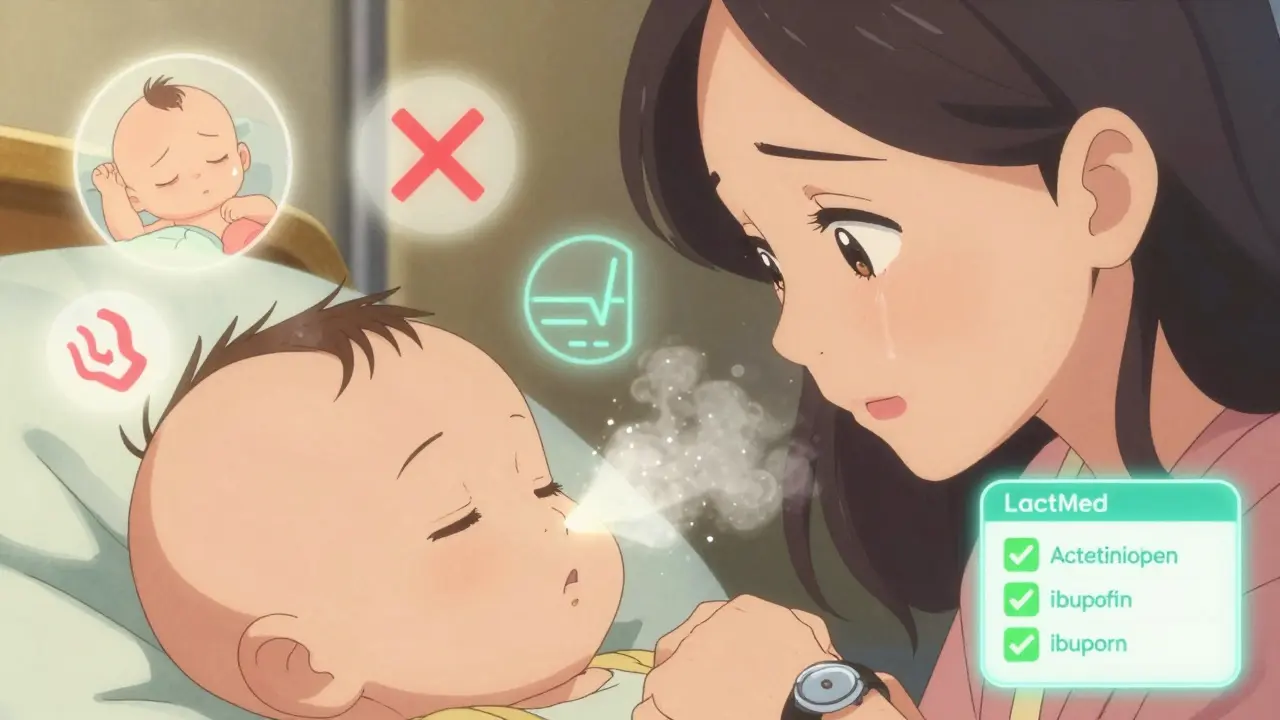
If you notice any of these after giving your baby medication through breast milk, stop the drug and call your pediatrician right away. Even one dose can cause a reaction in a sensitive baby. The Breastfeeding Network recommends watching your baby closely for 24 hours after each opioid dose-effects can be delayed.
What to Do If You Accidentally Took a Risky Medication
Maybe you took codeine before you knew the risk. Or your doctor prescribed it by mistake. Don’t panic. Here’s what to do:
- Stop the medication immediately.
- Monitor your baby closely for the next 24 hours. Watch for drowsiness, trouble feeding, or breathing changes.
- Don’t pump and dump. The drug is already in your system. Pumping won’t remove it from milk that’s already been produced.
- Call your pediatrician if your baby seems unusually sleepy or hard to wake. They may want to check oxygen levels or rule out opioid toxicity.
One accidental dose is unlikely to cause harm, but repeated doses are dangerous. Moving forward, switch to ibuprofen or acetaminophen-and talk to your doctor about safer alternatives.
What’s Changing in 2026? New Guidelines and Future Options
Things are getting better. In 2021, the Academy of Breastfeeding Medicine officially removed "pump and dump" recommendations after anesthesia. They now say: breastfeeding is safe right after surgery. Hospitals are updating protocols because of this.
Some clinics are starting to offer CYP2D6 genetic testing-this can tell you if you’re an ultra-rapid metabolizer. Mayo Clinic published a 2023 study showing this test could prevent dangerous opioid reactions. But it’s not standard yet. You’ll need to ask for it.
The LactMed database, updated in 2023, now includes detailed data on 15 pain medications. Doctors and pharmacists use it to make safer choices. If your provider doesn’t mention it, ask if they’ve checked it.
Bottom Line: What You Need to Remember
- Start with ibuprofen and acetaminophen-they’re the gold standard.
- Avoid codeine and tramadol completely. The risk isn’t worth it.
- If you need an opioid, use morphine or oxycodone-and only for a few days.
- Take meds right after feeding, not before.
- Watch your baby for drowsiness, poor feeding, or breathing trouble.
- Don’t stop breastfeeding. The benefits far outweigh the tiny risks from safe meds.
You’re doing the right thing by asking these questions. Your body is healing, and your baby needs you. With the right info, you can manage pain without sacrificing breastfeeding.


About Author


I never knew ibuprofen and acetaminophen were this safe! I was so paranoid after my C-section that I stuck to just ice packs and Tylenol, even when the pain was unbearable. Turns out, I was overthinking it. Took ibuprofen after my first feed and didn’t even notice a difference in my baby’s behavior. Seriously, this post should be mandatory reading for every new parent.
Let me tell you something, folks - this whole ‘safe meds while breastfeeding’ thing is a marketing ploy disguised as science. I mean, really? You’re telling me a chemical that passes into breast milk isn’t doing *something* to a newborn’s developing brain? I’ve seen babies turn into little zombie dolls after their moms took ‘just one’ oxycodone. And don’t get me started on the ‘pump and dump’ myth - that’s not even the real issue. The real issue is that we’re normalizing drug exposure in infants because it’s convenient. I’ve got a 3-year-old with sensory issues. I blame the meds. And yes, I’m that dad. And no, I won’t stop talking about it.
OMG I’m so glad someone finally said this! As an Indian mom who was told by my aunties to ‘stop breastfeeding if you take anything’ - I was stuck in a loop of guilt and pain. My mom even made me boil my milk and throw it out after I took ibuprofen 😭 But then I found LactMed and everything changed. My baby slept better, I slept better, and we kept breastfeeding for 18 months. You’re not alone, sisters. We got this. 💪🍼
so like... if u r an ultra rapid metabolizer, does that mean ur basically a superhero? like ur body turns pain meds into morphine turbo? sounds like a Marvel origin story. "she was just a mom... until she took tramadol... and became... MAMA MELTDOWN!" 🤡
Thank you for compiling this with such clarity. I’m a nurse in a labor unit and we’ve started distributing this exact guide to new parents postpartum. The shift from fear-based messaging to evidence-based guidance has been transformative. We now see fewer cases of early weaning due to medication fears. Small changes, big impact.
As a Canadian mother who breastfed two children through postoperative recovery, I must commend the rigor of this guidance. The alignment between ACOG, ABM, and LactMed represents a paradigm shift in perinatal care. I particularly appreciate the emphasis on timing over avoidance - a nuanced, science-driven approach that respects both maternal autonomy and infant safety. Well done.
Good info, but let’s be real - most hospitals still push codeine because it’s cheap and doctors don’t read guidelines. I got codeine after my C-section in 2022. My baby was so sleepy he missed three feeds. I had to wake him up with cold washcloths. Don’t trust the system. Always double-check.
STOP. THE. CODEINE. 🚫☠️ I’m not even kidding - my sister’s baby went into opioid withdrawal after 3 days of ‘just one pill’ because she was a super metabolizer. She didn’t even know what that meant. Now her kid is on a feeding tube. Don’t be that mom. Don’t be that doctor. Check LactMed. Ask for genetic testing. I’m still traumatized. 🥲
You’re not weak for needing pain relief. You’re not failing if you take morphine for 2 days. You’re a warrior. Your baby needs a mama who can sit up, hold them, and feed them without crying. You don’t have to suffer to prove you’re ‘natural.’ This post? It’s a gift. Thank you. Now go take that ibuprofen like a boss. 💪❤️
Just wanted to add - I took oxycodone after my c-section and took it right after nursing. Baby was fine. But I did notice he was a little extra sleepy for like 6 hours. So yeah, timing matters. Also, don’t forget to hydrate. Dehydration makes everything worse. Oh and yes, I typoed. I’m tired. 😴
This is the kind of info that saves lives. We need more of this. No more myths. No more guilt. Just facts. And if you’re a new parent reading this - you’re doing better than you think. Keep going. You’ve got this. 💯
The fact that this even needs explaining is embarrassing. If you’re breastfeeding, you should’ve researched this before giving birth. This isn’t rocket science.